
Miletus
Miletus was one of the great Ionian Greek cities of western Anatolia, a major maritime power and the birthplace of the Milesian school of philosophy. Today its extensive ruins near Balat in Aydın Province include one of Anatolia's largest ancient theatres.
Miletus is an ancient Greek city on the Aegean coast of western Anatolia, in the present-day Aydın Province of Türkiye, close to the village of Balat in the Söke district. It was one of the most influential Ionian Greek cities of antiquity, a leading maritime power, a founding centre of Greek philosophy and science, and a city whose harbour once opened directly onto the sea. Over the centuries the Büyük Menderes (Maeander) River silted up the gulf, leaving the ruins stranded several kilometres inland. What survives today is a large archaeological site with a monumental theatre, sanctuaries, baths, agoras and civic buildings that record roughly a millennium of Greek, Hellenistic, Roman and later occupation.
Where Miletus Stands
The ruins occupy a low, flat area on the edge of the Menderes delta plain, about 20 kilometres from the Aegean shoreline and near the modern coastal town of Didim. The plain is agricultural and largely level, framed by low hills to the south where the great theatre is cut into the slope. Because the ancient harbour is now dry land, visitors see the city in a landscape very different from the one its inhabitants knew: where ships once moored, cotton fields and reed beds now lie. The site is close to Balat, a small settlement whose mosque and older houses sit within and around part of the ancient city.
Miletus in the Bronze Age and Early Iron Age
Excavation has shown that the site was occupied from the Bronze Age, and Miletus appears in Hittite records under a name generally identified as Millawanda, indicating a settlement of political consequence in the Late Bronze Age. Mycenaean pottery and other imported goods point to early contacts with the Greek world. After the disruptions at the end of the Bronze Age, the area was settled by Ionian Greeks, and by the Archaic period Miletus had become one of the leading cities of the Ionian League, the confederation of Greek cities along the western coast of Anatolia.
A Maritime Power and the Milesian School
Archaic Miletus was a major colonising city, credited by ancient sources with founding numerous settlements around the Black Sea and in the Mediterranean. Its wealth came from trade, shipping and textiles. At the same time it became famous as an intellectual centre: Thales, Anaximander and Anaximenes, the thinkers of the so-called Milesian school, worked here in the 6th century BC and are traditionally regarded as among the first Greek philosophers to explain the natural world through reasoned enquiry rather than myth. The geographer and historian Hecataeus was also a Milesian. This combination of commerce and early science gives the city a distinctive place in Greek cultural history.
Destruction and Replanning
Miletus played a leading role in the Ionian Revolt against Persian rule. After the Greek defeat at the naval Battle of Lade in 494 BC, the Persian forces captured and largely destroyed the city. Miletus was rebuilt after the Persian Wars, and it is in this later period that the city was laid out on a regular grid of streets, a form of planned urban design associated by ancient tradition with Hippodamus of Miletus. This orthogonal plan, with blocks of housing and defined public zones, is one of the city's most important contributions to the history of urban planning.
Hellenistic and Roman Miletus
In the Hellenistic period Miletus continued as a significant port and civic centre, passing through the spheres of successive monarchies after the conquests of Alexander the Great. Under Roman rule the city prospered again and many of its surviving monuments were built or rebuilt. Roman Miletus received grand public architecture — baths, agoras, stoas, fountains and a monumental gateway — and its harbour remained active until the environmental changes caused by the river gradually closed it. The shift from a coastal port to an inland city is one of the defining processes of its later history.
The Theatre
The theatre of Miletus is the single most imposing structure on the site and one of the largest ancient theatres in Anatolia. It was originally laid out in the Hellenistic period and later enlarged and remodelled in Roman times, when the stage building and seating were substantially expanded. Its cavea is built into the hillside and commands a wide view across the plain toward the former gulf. The scale of the seating, the surviving vaulted substructures and the remains of the stage building make it the clearest illustration of the city's size and importance, and it is often the first monument visitors encounter.
The Delphinion and the Sanctuaries
The Delphinion was the sanctuary of Apollo Delphinios and served as one of the principal religious and civic centres of Miletus, associated with the city's public cults and with its official documents and decrees. The site preserves the foundations and architectural elements of this sanctuary in a form that can be read on the ground. Elsewhere in the city there are remains of other sanctuaries and religious buildings that reflect the changing beliefs of the inhabitants across the Greek, Roman and later periods, including evidence for non-Greek cults introduced in the Roman era.
Baths, Agoras and Civic Buildings
Roman Miletus was equipped with large public baths, several of which survive in recognisable plan, with their sequence of cold, warm and hot rooms and their supporting structures. The city also had marketplaces and colonnaded streets, council buildings and a stadium area, and monumental fountains such as the Ionic Stoa complex and nymphaea that distributed water through the urban centre. Taken together, these remains show a fully equipped Roman provincial city rather than an isolated ruin.
The Market Gate and the Movement of Antiquities
One of the city's most celebrated structures, the Market Gate of Miletus, a Roman monumental gateway from the southern agora, was removed in the early 20th century and reconstructed in Berlin. Its absence from the site is a reminder of how early excavations divided the physical heritage of Miletus between the place itself and distant museums. The monumental gate remains closely identified with Miletus even though it no longer stands in Aydın Province.
The Sacred Way and the Harbour
Miletus was linked to the great sanctuary of Apollo at Didyma by a processional route known as the Sacred Way, along which pilgrims and officials travelled between the city and the oracle. The harbour area, today silted and inland, was once the economic heart of the city, and traces of harbour installations and associated monuments survive in the lower parts of the site. The gradual displacement of the coastline by the Maeander is the reason the modern setting feels so different from the ancient one.
Byzantine Decline and the İlyas Bey Mosque
As the harbour failed and the regional balance of power shifted, Miletus declined in the Byzantine period, shrinking from a great port to a smaller settlement. In the early 15th century the Islamic monument known as the İlyas Bey Mosque was built at Balat by the Menteşe ruler İlyas Bey, using spolia and stone from the ancient city. It stands today as a well-preserved example of the region's later architectural history and shows how the site was continuously reoccupied long after classical antiquity.
Excavation and Research
Systematic excavation of Miletus began in the late 19th century under German direction and has continued, in various phases, into modern times. This long campaign has produced detailed knowledge of the city's grid plan, its public buildings, its sanctuaries and its harbours, and has made Miletus one of the better-documented ancient cities of the eastern Mediterranean. Research continues to refine the chronology of the site and the relationship between the city and its changing environment.
What to See on the Ground
Visitors can walk through the theatre, the sanctuary remains, the bath complexes, the agoras and the stretches of ancient street that reveal the grid layout. The site is extensive and the monuments are spread across open ground, so a visit involves a good deal of walking in the sun. Information on site helps identify the main structures. The combination of Greek planning, Hellenistic and Roman architecture, and later Islamic building at Balat makes Miletus unusual among Anatolian archaeological sites in the range of periods it displays in one place.
Practical Visiting Context
The ruins lie near Balat in the Söke district of Aydın Province, reachable by road from the coastal towns around Didim and from Söke. Spring and autumn are generally the most comfortable seasons, as summers in the delta plain are hot and the site offers little shade. Because the terrain is mostly flat and the paths are over ancient stone and earth, sturdy footwear is useful. Facilities are limited, so it is sensible to plan accordingly.
Nearby Historic Places
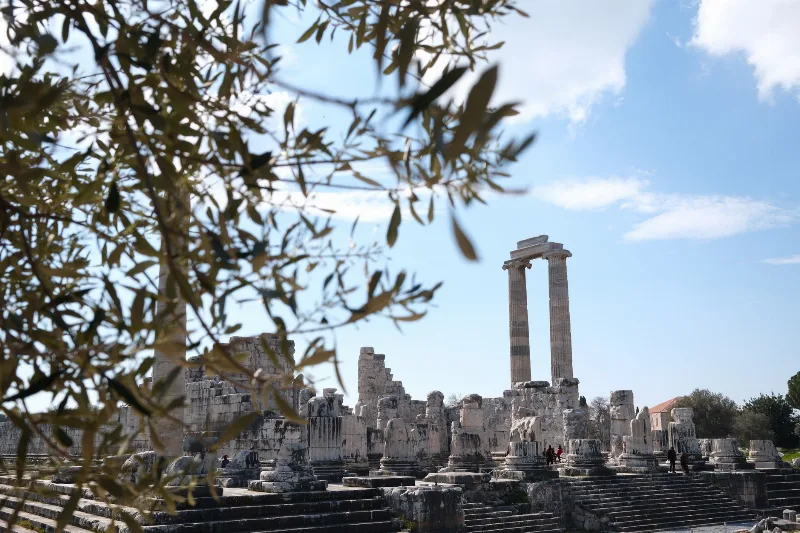
Miletus is close to two other major ancient sites: Didyma, with the vast Temple of Apollo and the oracle, and Priene, a carefully planned Greek city on a hillside above the plain. Together with Miletus they form a natural group of Ionian Greek sites in the same region. The Menderes delta and the nearby Lake Bafa, associated with the ancient city of Latmus, add further context to the landscape in which Miletus rose and declined.
Routes
All routes →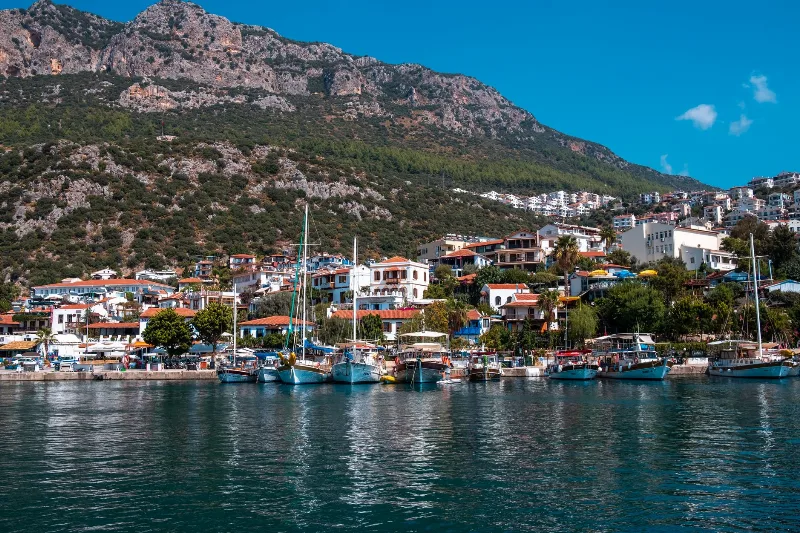
5-Day Antalya to Fethiye Coastal Route
A five-day driving itinerary along Turkey's Mediterranean shore, linking Antalya, Phaselis, Olympos, Demre, Kekova, Kaş, Kalkan, Patara and Fethiye. The route is linear, coastal for most of its length, with short inland detours to Lycian ruins.
Explore →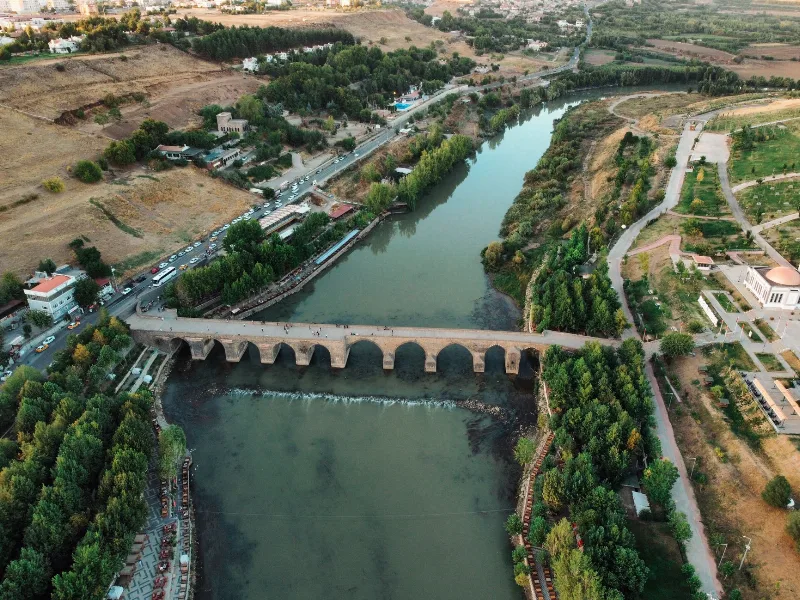
5-Day Tigris and Euphrates Route
A five-day, east-to-west journey across Southeastern Anatolia from Diyarbakır to Gaziantep, following the Tigris and Euphrates through Mardin, Şanlıurfa, Göbeklitepe and Harran.
Explore →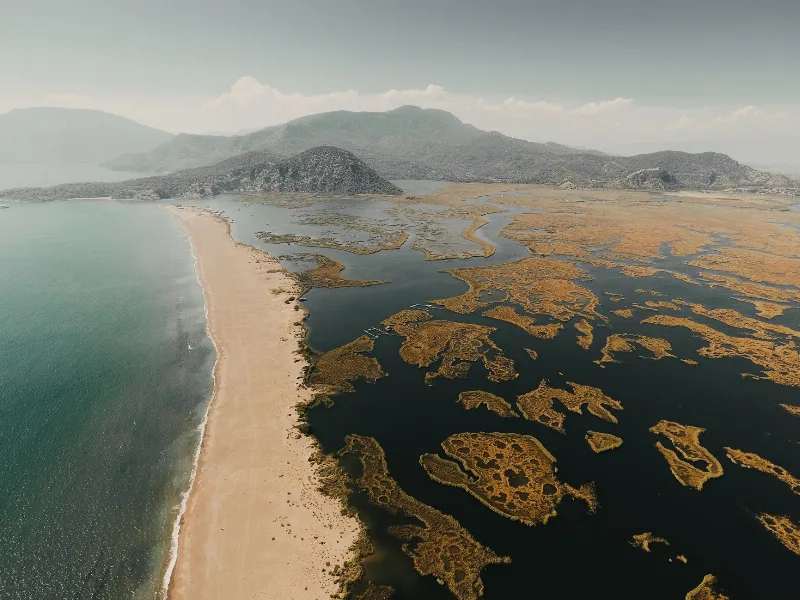
4-Day Marmaris and Dalyan Route
A four-day linear route that starts in Marmaris, crosses the Gulf of Gökova and Lake Köyceğiz, and ends around the river, rock tombs and turtle beach of Dalyan.
Explore →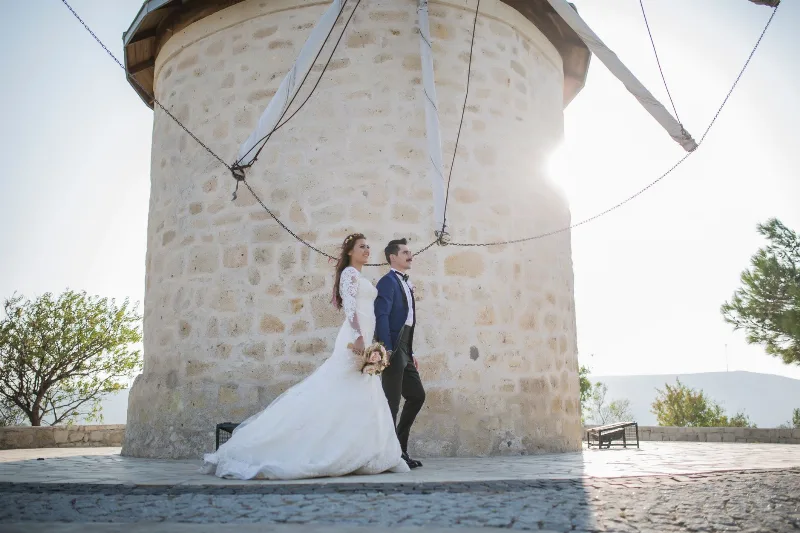
2-Day Alaçatı and Çeşme Route
A compact two-day Aegean route that starts among the windmills and stone lanes of Alaçatı and finishes at the castle, harbour and thermal beaches of Çeşme, all on the same peninsula west of İzmir.
Explore →Related content
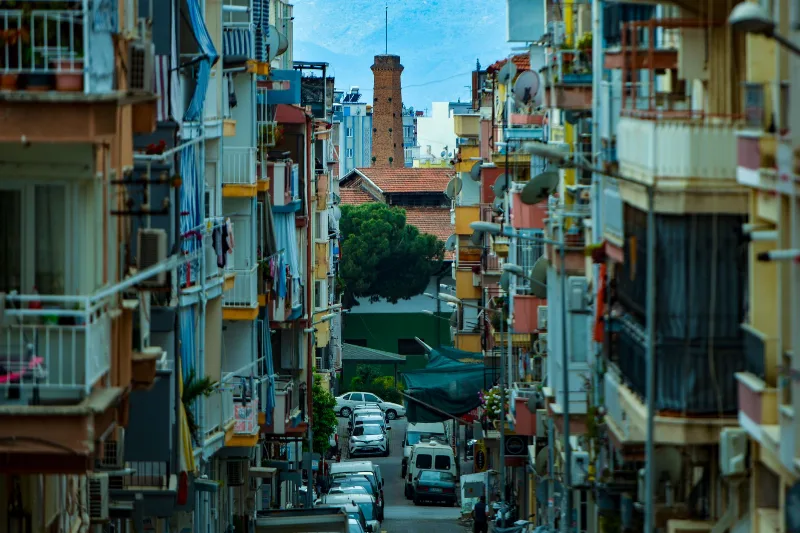
Aydın
Aydın is the inland capital of Aydın Province in Türkiye's Aegean region, recognised for its fig production and its position between the fertile Büyük Menderes valley, the coastal district of Kuşadası and several major ancient sites.
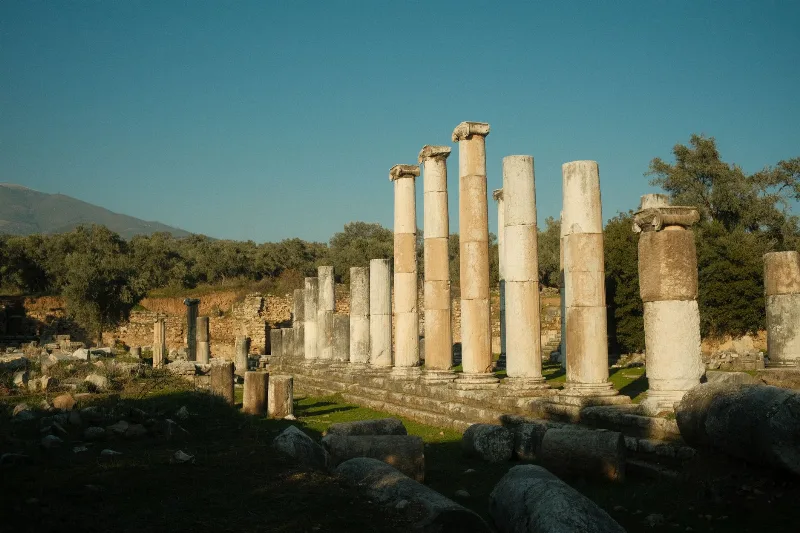
Söke
Söke is an agricultural district in Aydın Province, set on the fertile Büyük Menderes plain near the Aegean coast. It is known for cotton and olive production and provides access to Priene and the Dilek Peninsula National Park.
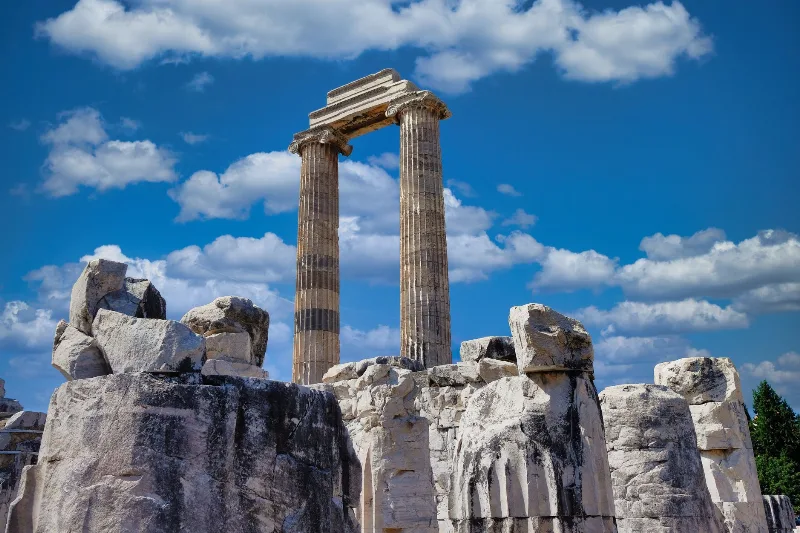
Didim
Didim is a coastal district in Aydın Province on Türkiye's Aegean shore, built around the ancient oracular sanctuary of Didyma and its Temple of Apollo, with the sandy beach of Altınkum at its holiday centre.
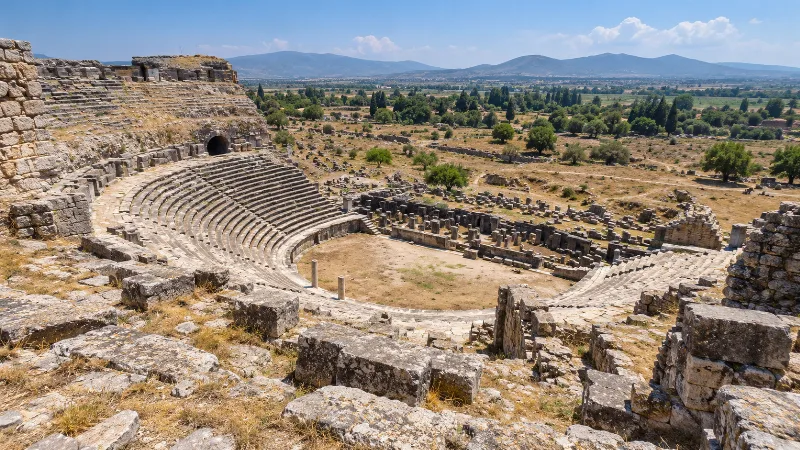
Miletus
Miletus is an ancient Greek city in Aydın Province whose Great Theatre, harbour monuments and Miletian school of philosophy made it one of the defining sites of Ionia — now stranded inland by the Meander River.
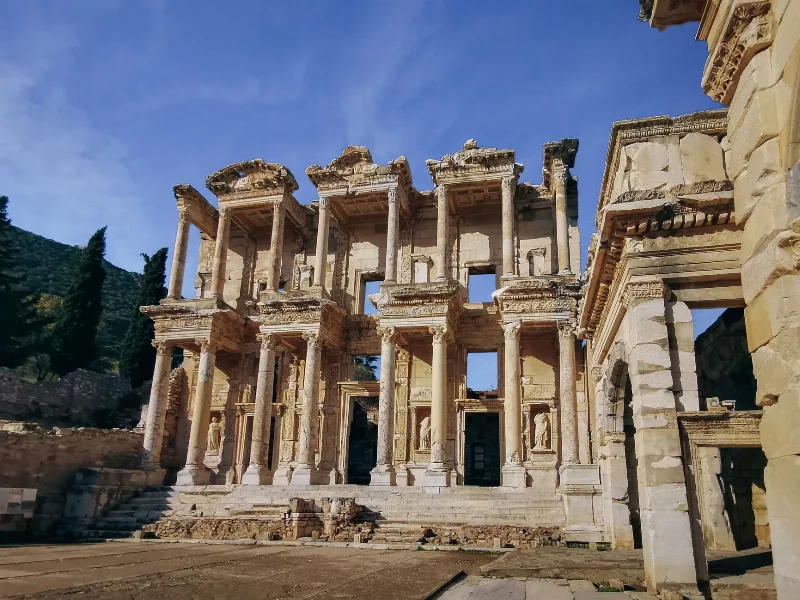
6-Day Aegean Ancient Cities Route
A six-day linear journey from Izmir to Denizli through the great ancient cities of the Aegean, linking Ephesus, Priene, Miletus, Didyma, Lake Bafa, Pamukkale, Laodicea and Aphrodisias in one coherent corridor.
Priene
Priene is a planned ancient Greek city on the slopes of Mount Mycale in Aydın Province, Türkiye, whose grid streets, theatre and Temple of Athena Polias still trace a Hellenistic urban layout.