
4-Day Marmaris and Dalyan Route
A four-day linear route that starts in Marmaris, crosses the Gulf of Gökova and Lake Köyceğiz, and ends around the river, rock tombs and turtle beach of Dalyan.
This four-day route crosses the southwestern corner of Türkiye in Muğla province, starting in Marmaris and finishing in Dalyan. It follows a short, coherent stretch of coast and its immediate hinterland, linking the Gulf of Gökova, the town of Köyceğiz with its lake, the Dalyan river delta and the ancient city of Kaunos. The character of the journey shifts as it goes: the first day is urban and coastal, the second is a travel day between two very different kinds of water, and the last two days slow down around a river, a lake and a protected beach.
The route is linear rather than circular. Most travellers drive it, because the transfer between Marmaris and Dalyan rewards a few stops along the way, but the Dalyan end of the trip works well on foot and by boat, with river and lake crossings replacing the car. Each day below is kept geographically tight so that no long backtracking is required.
Day 1: Marmaris and the surrounding coast
The itinerary begins in Marmaris, the largest settlement on this stretch of the Muğla coast and the westernmost point of the route. Everything after this day heads east, so the first day is best spent understanding where you are: the harbour and marina, the compact old quarter of Kaleiçi with its narrow whitewashed lanes, the small castle that overlooks the bay, and the long seafront promenade that connects the centre to the beach areas.
Marmaris is also a base for the water around it. Boats leave the harbour for the coves and small islands of the gulf, and the pine-covered hills behind the town form a protected natural area that runs down to the shoreline. South of the centre, the coast road passes İçmeler and then continues onto the Bozburun peninsula, where villages such as Turunç and Kumlubük sit in sheltered bays; above Kumlubük, on a ridge facing the sea, stand the ruins of the ancient city of Amos. This is enough for a full day without leaving the district, and it sets up the coastal landscapes that the next day continues eastward.
Day 2: Marmaris to Dalyan via the Gulf of Gökova and Lake Köyceğiz
Leave Marmaris heading east. The road climbs over pine ridges above the Gulf of Gökova, with long views back along the water, then drops down to Akyaka at the head of the gulf. Akyaka is a small, deliberately quiet village where the Azmak stream reaches the sea, known for its low white houses, its riverside walks and its beach on the gulf. It is a natural first stop because it sits directly on the line between Marmaris and the lake country further inland.
From Akyaka, continue east and then south toward Köyceğiz. The town stands at the northern end of Lake Köyceğiz, a large brackish lake whose water reaches the Mediterranean through a single channel – the river that runs through Dalyan. Follow the lake's eastern shore southward, past citrus groves and pine slopes, and the landscape closes in: the open gulf is replaced by an enclosed lake, and the lake in turn narrows into a delta. Dalyan is the natural place to stop for the night, and the shift from sea coast to lake to river is the defining geography of this route.
Day 3: Dalyan, Kaunos and the Lycian rock tombs
Dalyan is built along the river, and this day is mostly spent on the water. Boats head along the channel to the cliff where the Lycian rock tombs are cut into the rock face, high above the river and clearly visible from the water. These tombs are the reason the Dalyan riverfront is so distinctive, and they are best seen from a boat rather than from the road.
Across the river from the tombs lies Kaunos, the ancient city they belong to. A short but uphill walk from the landing point leads to a site with a theatre, defensive walls and the remains of a harbour that has long since been separated from the sea by silt. Allow time here, because the walking is the main effort of the day.
In the afternoon, return to the water and head toward the lake side of the delta, where the Sultaniye thermal springs and mud baths sit at the southern end of Lake Köyceğiz and are reached by boat from Dalyan. Back in town in the evening, the riverfront is the centre of life, and the regional produce of the Köyceğiz and Dalyan area – citrus in particular – is part of the local character. Everything on this day belongs to the same river-and-lake system, which is why it fits together so neatly without any driving.
Day 4: Iztuzu Beach and the end of the route
The final day belongs to Iztuzu Beach, the long sandbar where the Dalyan channel meets the Mediterranean. It is a protected nesting beach for loggerhead turtles, and part of it is closed during the nesting season, so access follows the rules in force at the time of your visit. It can be reached by boat from Dalyan on one side or by road on the other, and either approach gives a strong sense of how the delta ends: river on one side, open sea on the other.
This is where the route finishes. Most travellers return to Dalyan for their last night, while those leaving the region continue east towards Dalaman, which lies along the same corridor. Four days is enough to move from a busy harbour town to a quiet river village and a protected beach without ever doubling back.
Season, terrain and travel style
Spring and autumn are the most comfortable periods for this route. Summer is hot and humid along the coast and busy in Marmaris, while winter is mild on the coast but can affect boat trips and beach access. The driving section between Marmaris and the gulf crosses mountain terrain on winding roads; the ground around Lake Köyceğiz and the delta is flatter and gentler.
Because the route is linear, the simplest approach is to drive it one way and finish at the Dalyan end, using boats for the river and lake crossings. A ferry also links Marmaris westwards to the Datça peninsula, but that direction leads away from Dalyan and belongs to a separate journey. On the ground, walking is concentrated at Kaunos and on the beaches, and the Dalyan section needs no car at all.
Remarkable Places
See all places →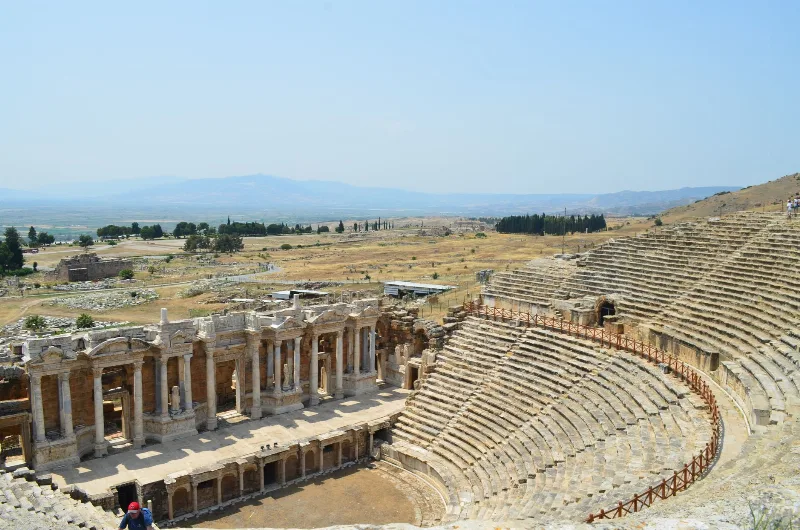
Letoon
Letoon is a Lycian sanctuary near Xanthos in Muğla Province, dedicated to Leto, Artemis and Apollo. Its three temples, theatre and trilingual inscription make it one of southwestern Turkey’s most significant archaeological sites.
Explore →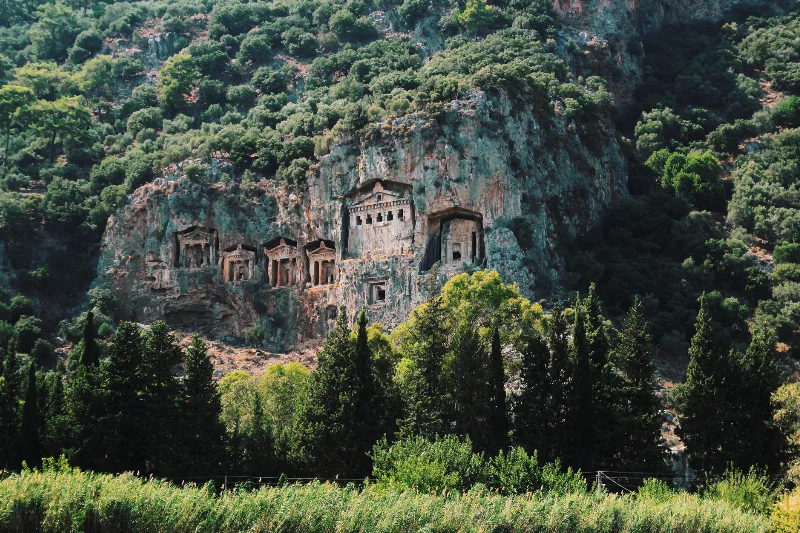
Kaunos
Kaunos is an ancient Carian city on the Dalyan River in Muğla Province, known for its temple-style rock-cut tombs and the extensive ruins of a harbour that silted up centuries ago.
Explore →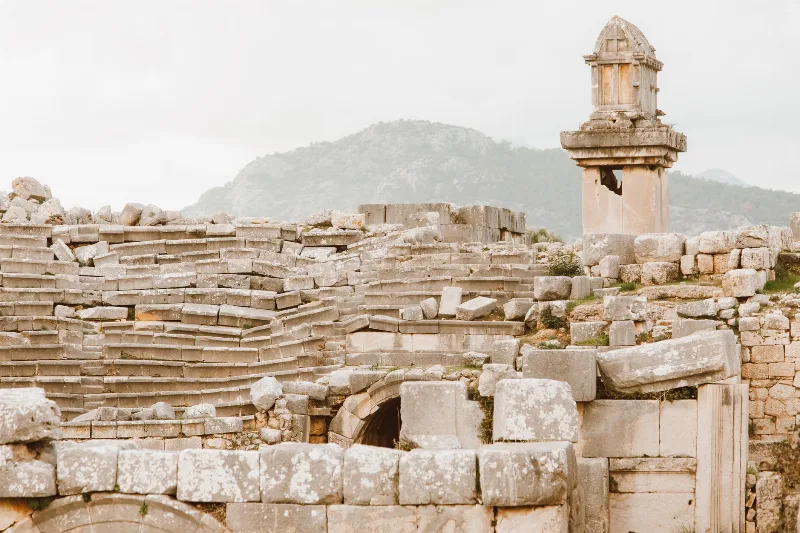
Xanthos
Xanthos is an ancient Lycian city in Antalya Province and a UNESCO World Heritage Site, known for its Lycian tombs, Roman theatre and role as a leading city of Lycia.
Explore →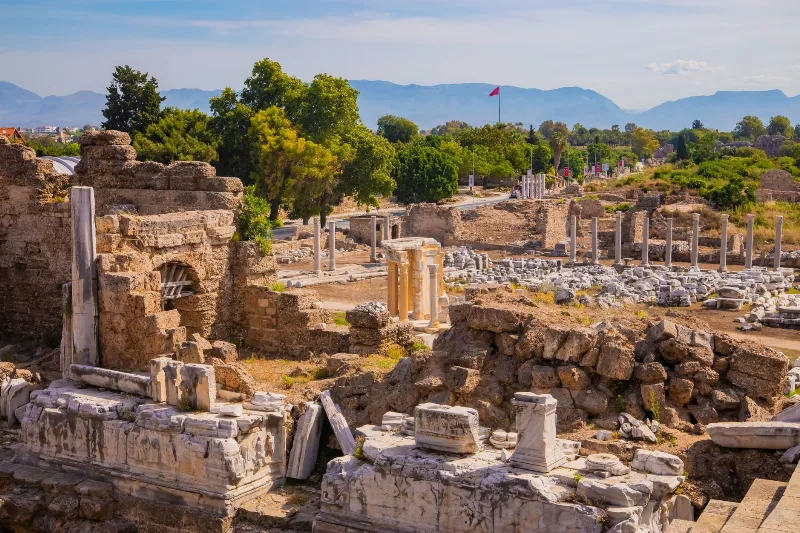
Phaselis
Phaselis is a Rhodian-founded port city on the eastern Lycian coast, where paved streets, agoras, baths and a small theatre stand among pines between three sheltered bays.
Explore →Related content
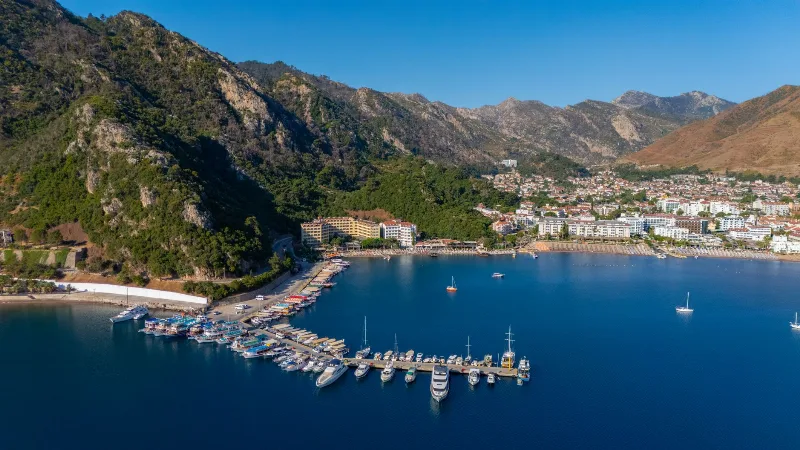
Marmaris
Marmaris is a dynamic port city on the Turquoise Coast, known for its vibrant marinas and lively nightlife, offering scenic harbor views.
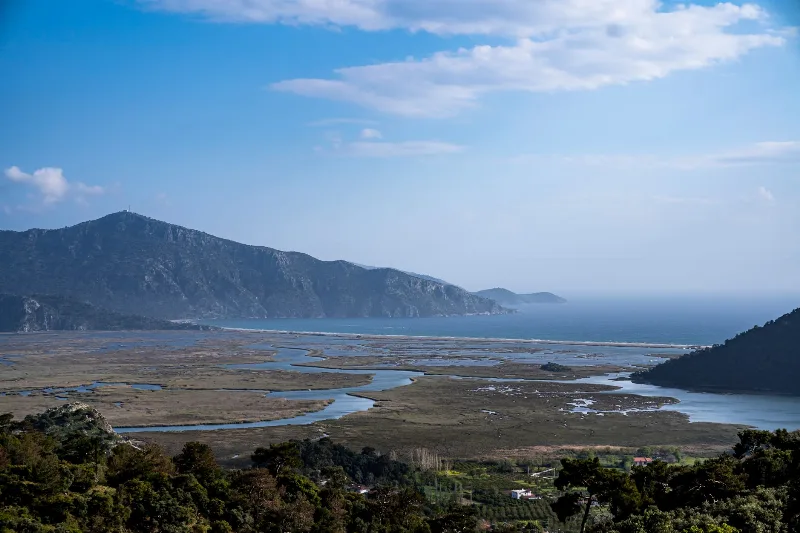
Muğla
Muğla is a captivating province in southwestern Türkiye, renowned for its stunning Aegean coastline and rich cultural heritage.
Kaunos
Kaunos is an ancient Carian city on the Dalyan River in Muğla Province, known for its temple-style rock-cut tombs and the extensive ruins of a harbour that silted up centuries ago.
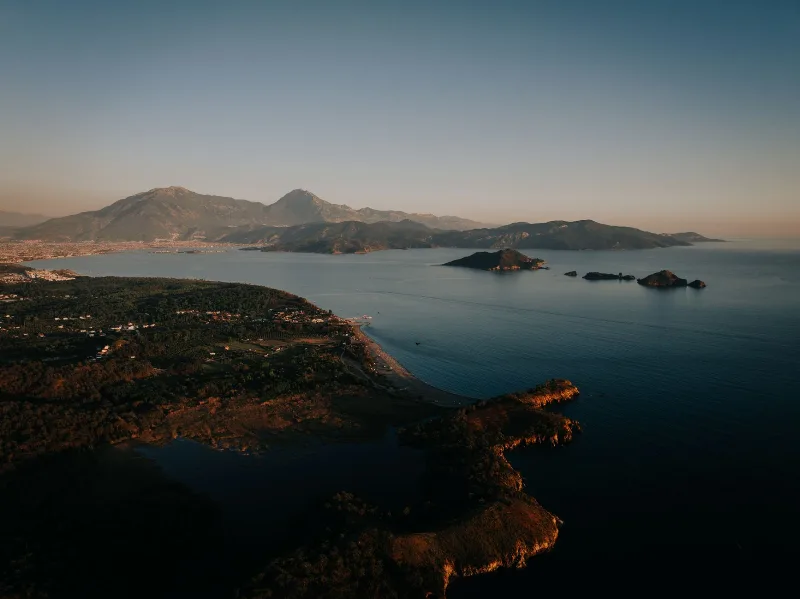
6-Day Mediterranean Coast Route: Antalya to Marmaris
A six-day linear route along Türkiye's Mediterranean coast, linking Antalya, Olympos, Demre, Kekova, Kaş, Kalkan, Patara, Fethiye and Dalyan before finishing in Marmaris. It mixes ancient cities, long beaches and small harbour towns on a continuous westward drive.
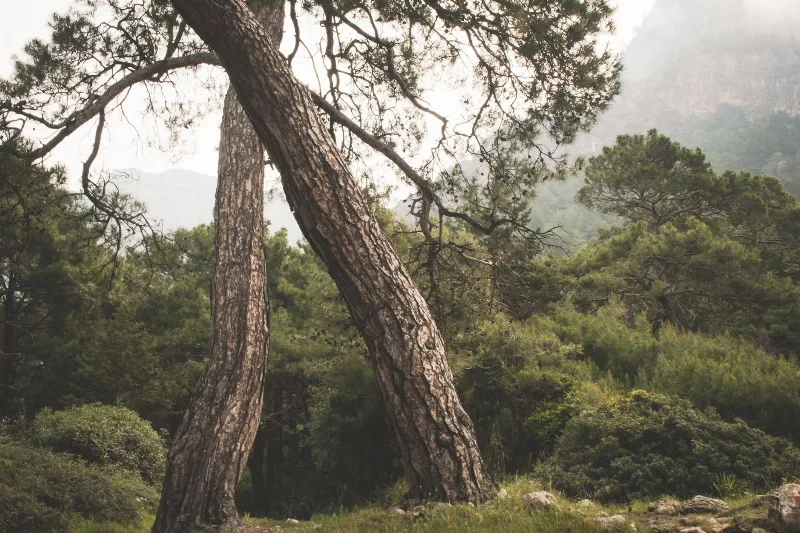
Pine Honey Harvest in Marmaris, Muğla
Every autumn, the pine forests around Marmaris in Muğla Province host Türkiye's pine honey harvest, when beekeepers collect honey made from pine-tree honeydew rather than flower nectar. The timing of this harvest depends heavily on how the season's weather unfolds.
Dalyan Rock Tombs and River Reed Boats in Muğla
Dalyan in Muğla pairs ancient Lycian tombs carved into a cliff with a slow, reed-fringed delta where flat-bottomed boats still carry passengers between lake, river and sea.