
Dalyan Rock Tombs and River Reed Boats in Muğla
Dalyan in Muğla pairs ancient Lycian tombs carved into a cliff with a slow, reed-fringed delta where flat-bottomed boats still carry passengers between lake, river and sea.
Dalyan is a small town in the Ortaca district of Muğla Province, sitting where the Dalyan River makes its unhurried way between Lake Köyceğiz and the Mediterranean. Within a few hundred metres of the waterfront, two very different attractions present themselves: a limestone cliff honeycombed with Lycian rock-cut tombs, and a line of low, flat-bottomed boats waiting to carry passengers through the reedy channels of the delta.
A River Town Between Lake and Sea
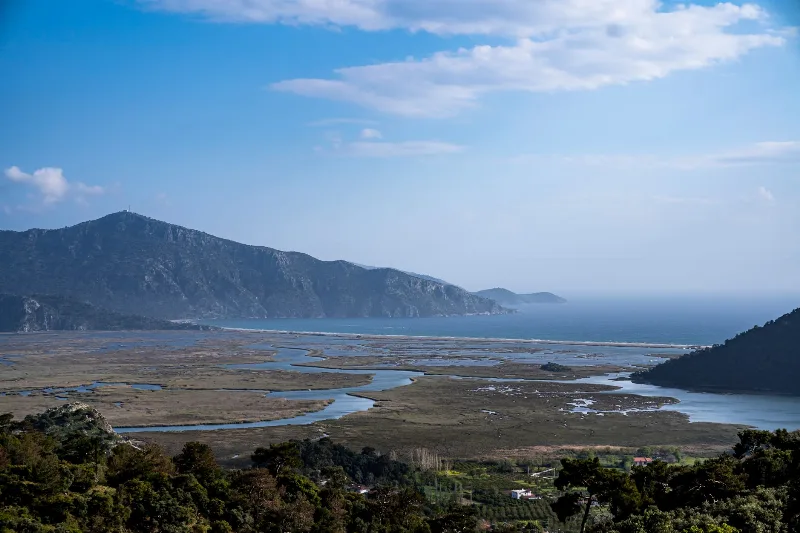
The town occupies the eastern bank of the river, known in antiquity as the Calbis, roughly midway between the lake and the river mouth. The land here is flat and green, a patchwork of citrus groves, pomegranate orchards, cotton fields and glasshouses that spreads out towards Ortaca and Dalaman. Because the river is wide but shallow, with sandbanks shifting underneath the water, life in Dalyan has always been oriented towards the current rather than the road. From the riverside cafés, the view runs upstream towards the reedbeds of the delta and downstream towards the long sandbar that closes the river off from the open sea.
The Rock Tombs Above Dalyan
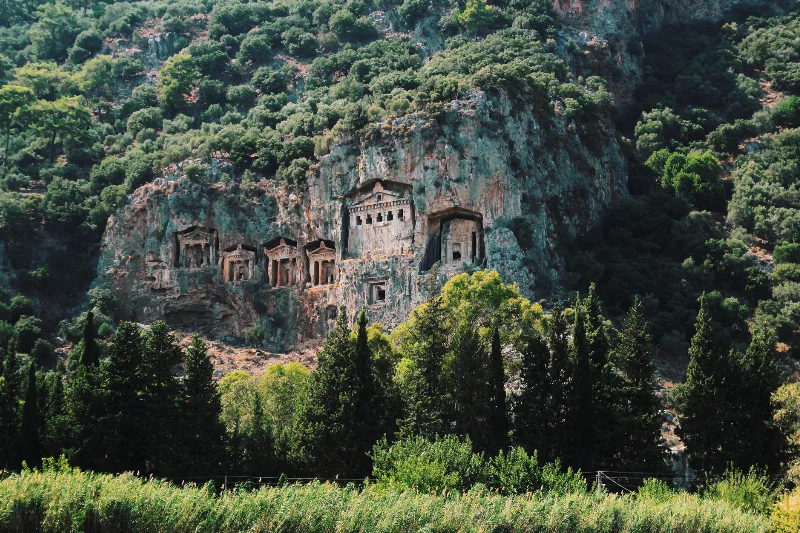
Cut high into the cliff face on the eastern side of the valley are the tombs of ancient Kaunos, carved by hand into the rock around the fourth century BC. Their façades imitate the fronts of temples, or perhaps the timber houses of the period, with two Ionic-style columns supporting a triangular pediment above a plain doorway. Some are finished to a polish; others remain rough and clearly abandoned mid-work, which makes the sequence of building easy to read. A few carry inscriptions in Greek script. Local people call the group the King's Tombs, and although the burials inside were long ago emptied, the effect from below is still striking, especially in late afternoon light when the shapes sharpen against the shadowed rock.
The tombs belong to the city on the opposite bank, and the two sites are best understood together: the living settlement with its theatre, baths and harbour on the western shore, and the dead laid out in the cliff across the water.
Reed Boats and the Delta Channels
Travel on the river has always been by flat-hulled boat, shallow enough to pass over bars and narrow enough to slip between the reeds that give the delta much of its character. Boats are commonly described as reed boats, recalling a time when bundles of cut reed formed part of the hull; today most are timber, but the low, open profile has survived. Boatmen work them with poles, oars or small engines, steering upstream towards the lake or downstream towards the beach.
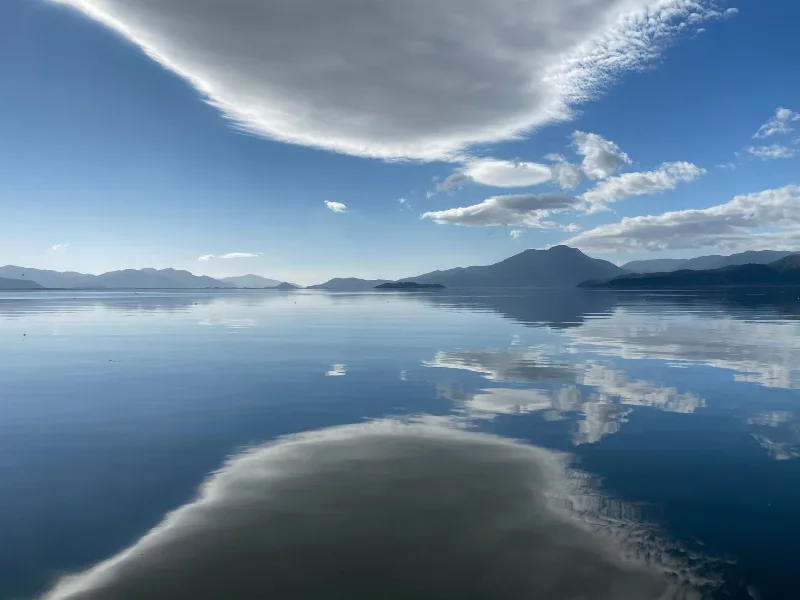
The reedbeds themselves are a working part of the landscape. Cut reed has long been used locally for thatching, matting and light fencing, and the harvesting cycles follow the growth of the stems through the warm months. Along the channels, the water is calm and often glassy, reflecting the bamboo, tamarisk and eucalyptus that line the banks.
Sand, Turtles and a Protected Delta
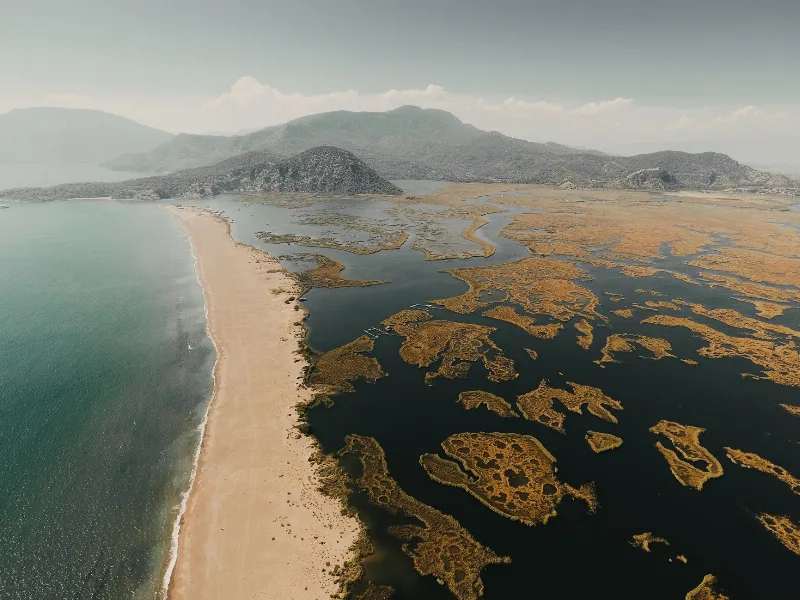
At the river mouth, the current meets the sea at İztuzu, a sandbar several kilometres long that separates fresh water from salt and forms one of the most important loggerhead turtle nesting beaches in the Mediterranean. The delta, the dunes and the beach together fall within a specially protected environmental area, which has kept the shoreline free of large-scale building and left the channels and marshes largely as they are.
Birdlife is abundant and easy to watch from a boat: herons, egrets, cormorants, terns and kingfishers are all common, together with smaller waders along the muddy edges of the sandbanks.
Kaunos and the Surrounding Countryside
A short ferry ride across the river reaches the ruins of Kaunos, where a hillside theatre, a Roman bath complex, a fountain house, an agora and stretches of fortification wall are spread among carob and pine. Inland from the town, thermal mud baths fed by mineral-rich springs offer a different kind of pause, while the coast nearby opens onto quieter stretches of beach and wooded coves around Sarıgerme and Ekincik.
Local life keeps to an agricultural rhythm. Citrus is picked through the winter, pomegranates and cotton in autumn, and honey from the surrounding hills appears in village shops and weekly markets across the district. Spring brings fresh greens and wild herbs to the tables, and the long summer fills the river with boats moving at the pace the water allows — which, in Dalyan, has never been especially quick.
Related content
Muğla
Muğla is a captivating province in southwestern Türkiye, renowned for its stunning Aegean coastline and rich cultural heritage.
Kaunos
Kaunos is an ancient Carian city on the Dalyan River in Muğla Province, known for its temple-style rock-cut tombs and the extensive ruins of a harbour that silted up centuries ago.
Köyceğiz Lake and Hot Springs
A guide to Köyceğiz Lake in Muğla, its mineral hot springs, the Dalyan channel, İztuzu Beach and the wetland landscapes of southwestern Türkiye.
4-Day Marmaris and Dalyan Route
A four-day linear route that starts in Marmaris, crosses the Gulf of Gökova and Lake Köyceğiz, and ends around the river, rock tombs and turtle beach of Dalyan.
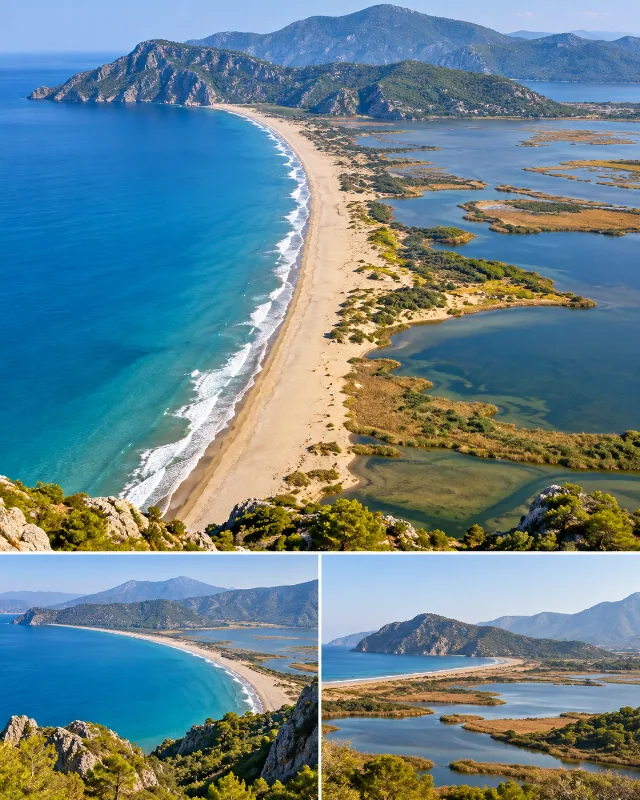
İztuzu Beach
A long sandy beach near Dalyan where the Mediterranean Sea meets the wetlands and waterways of the Köyceğiz-Dalyan system.
The Lycian Rock Tombs of Dalyan
Cut into the cliffs above the Dalyan River, the rock tombs of ancient Kaunos preserve the funerary architecture of Caria and frame one of the most distinctive landscapes on Türkiye's southwestern coast.
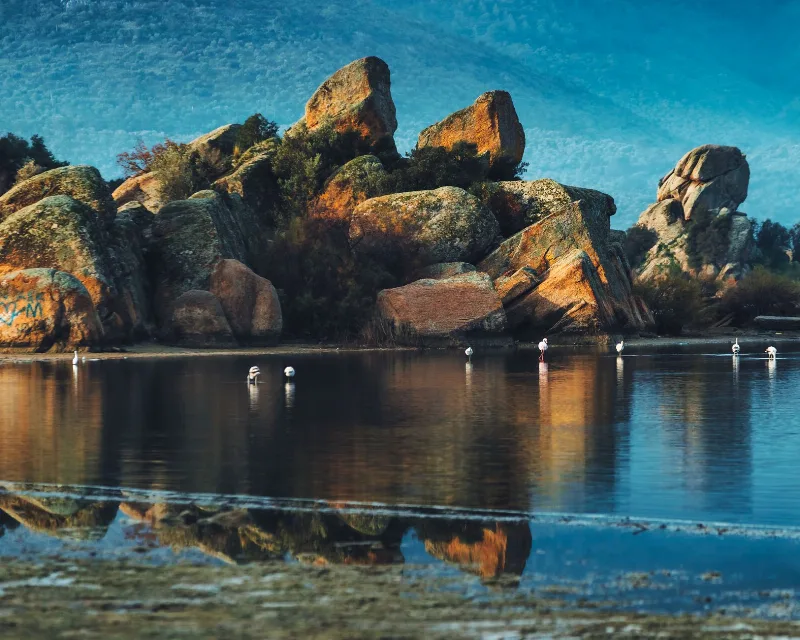
Bird Migration in Lake Bafa, Muğla
Lake Bafa in Muğla sits on a major bird route, and its shallow brackish water fills with migrating and wintering waterbirds during the spring and autumn passages. Timing shifts each year with water levels and weather, which is why the lake is worth visiting across a window rather than on a fixed date.
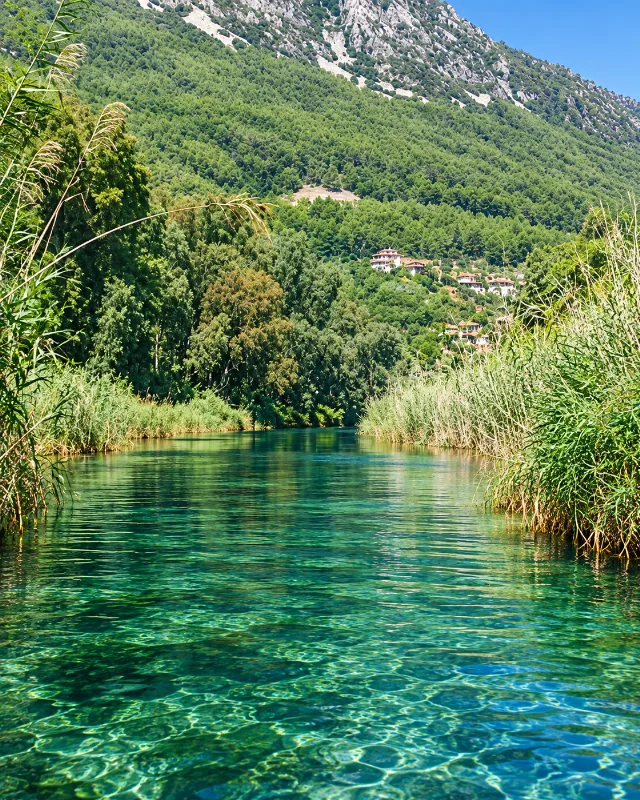
Akyaka
Akyaka is a small settlement in Ula district, Muğla, on the Gulf of Gökova, recognised for its white Ula-style houses with timber bay windows and for the cold, clear Azmak River that runs through it to the sea.