
Letoon
Letoon is a Lycian sanctuary near Xanthos in Muğla Province, dedicated to Leto, Artemis and Apollo. Its three temples, theatre and trilingual inscription make it one of southwestern Turkey’s most significant archaeological sites.
Letoon is an ancient sanctuary in Muğla Province, southwestern Turkey, dedicated to the goddess Leto and her twin children Artemis and Apollo. It lies near the village of Kumluova in the Seydikemer district, on low ground in the Xanthos Valley and about four kilometres from the archaeological site of Xanthos. The sanctuary was a major religious centre of Lycia, and its ruins—three temples, a theatre and structures associated with a sacred spring—form part of the UNESCO World Heritage Site inscribed as Xanthos-Letoon. Letoon was not a city in the ordinary sense; it was a sacred place where cult, political identity and landscape met.
A Lycian Sanctuary Dedicated to Leto, Artemis and Apollo
The core of Letoon is a group of three temples standing side by side and traditionally identified with Leto, Artemis and Apollo. The most prominent of the three is associated with Leto, the mother of the twin deities, while the other two temples complete a family group that gave the sanctuary its religious logic. The temples were built and rebuilt over centuries, with Hellenistic and Roman phases visible in the plans and surviving masonry. Their position, close together and on flat ground, makes the sanctuary feel different from a hilltop acropolis; the emphasis is on ritual space rather than defence or display.
The choice of site was closely connected with water. A spring fed the sanctuary, and the presence of water helps explain both the sacred character of the place and the later monumental fountain, or nymphaeum, built there in the Roman period. Letoon served as one of the most important religious centres of Lycia and had a close relationship with Xanthos, the leading city of the region. The sanctuary was therefore not isolated from Lycian political life; it was a place where local identity, cult practice and intercity authority came together.
The Trilingual Inscription and Letoon’s Wider Importance
Letoon is known beyond Lycia for a trilingual inscription found at the site in 1973. The text was carved in Lycian, Greek and Aramaic, and it records an official document connected with the sanctuary. Because the same content appears in three languages, the inscription became essential for understanding Lycian, a language that is otherwise difficult to reconstruct. The discovery gave scholars a key to a language and a culture that had survived mainly in short inscriptions and in the accounts of others.
The trilingual text also shows that Letoon was not merely a local shrine. It was a place where different languages and political traditions met, and where decisions affecting the cult were recorded for more than one audience. For a visitor, this is one of the most important things to understand about the site: the ruins are subtle, but their historical significance is considerable. Letoon helps explain how Lycia worked as a network of cities and sanctuaries, and why Xanthos and its sacred neighbour were treated as a single World Heritage property.
What Survives at the Archaeological Site
Visitors to Letoon see an open archaeological area rather than a reconstructed ancient city. The foundations and standing elements of the three temples are the central feature, and the theatre sits at the edge of the sanctuary. A monumental fountain structure, the nymphaeum, is another recognizable element, and traces of other religious and civic buildings are visible around the main group. Architectural fragments and inscriptions are scattered through the site, giving a sense of how much has been lost as well as how much can still be read on the ground.
Water remains part of the experience. The spring-fed ground can be damp, and reeds and marsh vegetation grow around parts of the ruins. This is not a polished visitor attraction with dramatic reconstructions; it is an archaeological landscape where the relationship between buildings, water and the plain is still legible. The temple foundations show different plans and phases, and the theatre provides a reminder that religious sanctuaries in the ancient world could also host performances and public gatherings. The site rewards slow looking rather than a quick circuit of monuments.
A Watered Landscape in the Xanthos Valley
Letoon sits on flat, low-lying land rather than on a hill. The setting is agricultural and wet, shaped by the Xanthos River plain and by the springs that rise near the sanctuary. This physical setting is central to the site’s identity. The contrast with Xanthos, which occupies a raised position, is part of the experience of visiting both places: Xanthos commands the valley, while Letoon lies within it, close to water and fields. The sanctuary’s location helps explain why it was associated with Leto and with the natural world rather than with military power.
The landscape also affects how the ruins are experienced today. Parts of the ground can be muddy or soft underfoot, and vegetation grows close to the masonry. In spring, the surrounding plain is green and the site can feel enclosed by cultivation and water; in dry months, the contrast between the damp sanctuary ground and the surrounding fields becomes more obvious. This is a place where the environment is not a backdrop but part of the archaeological record.
Access and Practical Visiting Information
Letoon is usually visited in combination with Xanthos, which is the closest major archaeological companion. The sanctuary is near Kumluova in the Seydikemer district, and road access is straightforward from the Fethiye and Kaş directions. Using your own vehicle or a taxi is the simplest way to reach the site, while local minibus routes may serve the village; verify current local transport arrangements before setting out. Opening hours and ticket arrangements can change by season, so check current official local information rather than relying on outdated guides.
The site is open-air and the paths are uneven, with loose stone and damp ground in places. Shoes with grip are more useful than smooth soles, and shade is limited around the ruins. Carry water and sun protection, especially in warmer months. Letoon is not a large, highly interpretive museum site; it is an archaeological area where the remains require some attention and prior knowledge. A short background reading about Lycia, Xanthos and the trilingual inscription will make the visit far more rewarding.
Seasonal Conditions and Timing
The Xanthos Valley has a Mediterranean climate, with hot, dry summers and milder, wetter winters. Spring and autumn are generally the most comfortable periods for walking around an open archaeological site, when temperatures are moderate and the landscape is green. Summer visits are possible but can be hot, with little shade among the ruins; morning is usually cooler and quieter. Winter rain can make the low ground at Letoon wet and muddy, and the site may feel more exposed in bad weather.
Because the sanctuary is spring-fed, damp conditions can persist even when the surrounding fields look dry. This matters for footwear and for expectations: Letoon is not a site where every surface is paved. The best time to visit is often a clear day in spring or autumn, when the light is softer and the water within the site is easy to see. For photography, the low, flat setting means that the temples and theatre are best understood in relation to the plain rather than from a single elevated viewpoint.
Before You Go and Nearby Places
Letoon is an archaeological site, not a reconstructed ancient town, and its importance lies in its religious continuity, its relationship with Xanthos and its epigraphic finds. Stay on established paths, do not climb on fragile masonry, and treat the inscriptions and architectural fragments as part of the site rather than as loose objects. The ruins are best understood as a sanctuary within a wider Lycian landscape, so a visit works well when paired with Xanthos and with the regional museum collections that hold finds from the area.
Nearby places that make sense in the same itinerary include Xanthos, the ancient Lycian capital with its own monuments and acropolis; Patara, with its long beach and ancient city; Tlos, another Lycian site set above the valley; and Fethiye, the main service centre for this part of Muğla Province. Saklıkent Canyon lies in the same district and offers a very different landscape experience. These places are not substitutes for Letoon; they help place the sanctuary within the broader history and geography of Lycia.
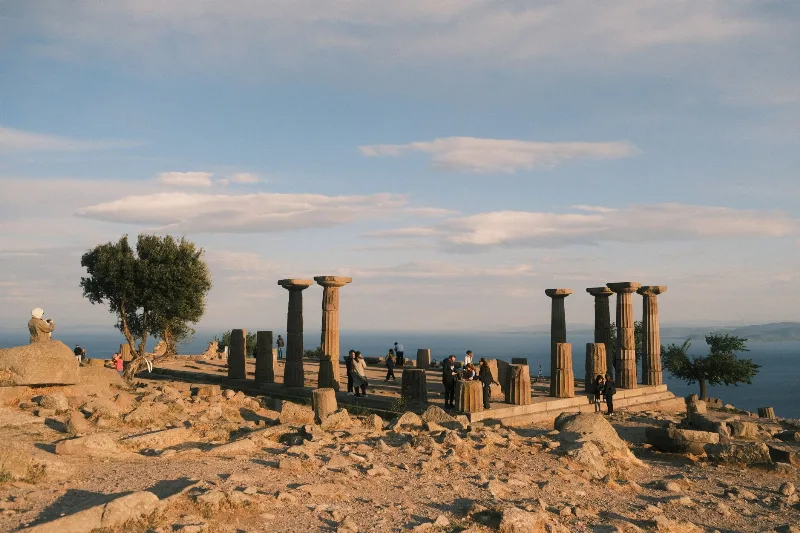
Related content
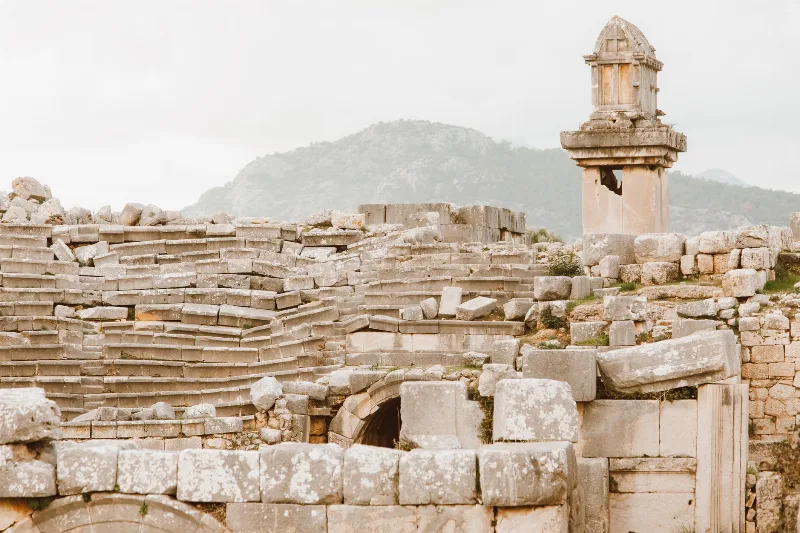
Xanthos
Xanthos was a leading city of Lycia and the seat of the Lycian League, on the frontier between the Antalya and Muğla provinces of Türkiye. Its surviving theatre, agora and tomb monuments, together with the nearby sanctuary of Letoon, form a UNESCO World Heritage Site.
Xanthos
Xanthos is an ancient Lycian city in Antalya Province and a UNESCO World Heritage Site, known for its Lycian tombs, Roman theatre and role as a leading city of Lycia.
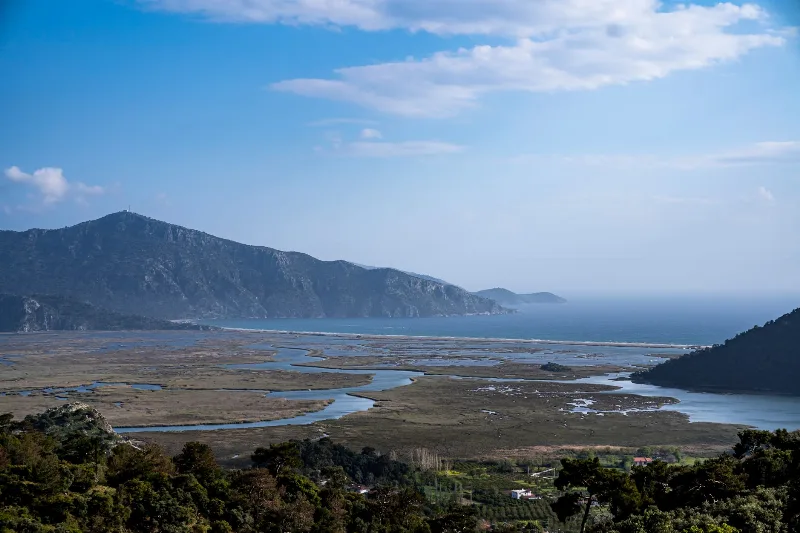
Muğla
Muğla is a captivating province in southwestern Türkiye, renowned for its stunning Aegean coastline and rich cultural heritage.
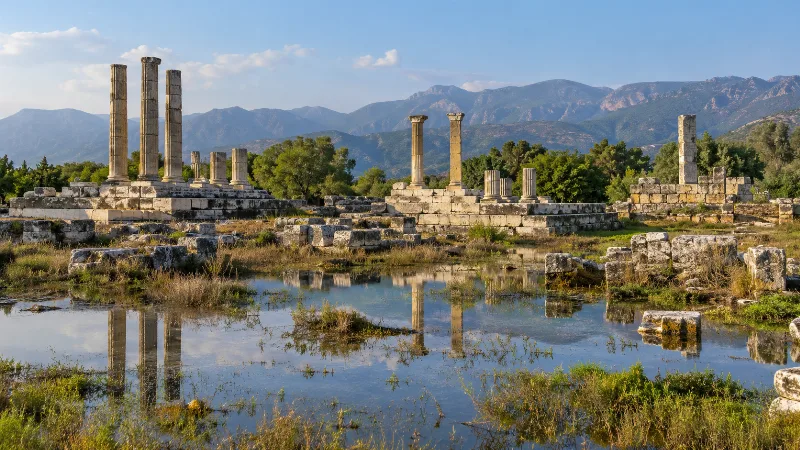
Letoon
Letoon is the ancient Lycian sanctuary of Leto near Xanthos in Muğla Province, home to three temples and the trilingual inscription that helped decipher the Lycian language.
5-Day Fethiye to Kaş Lycian Coast Route
A five-day linear route along the Lycian coast from Fethiye to Kaş, linking Ölüdeniz, Kabak, the Xanthos valley, Patara and Kalkan by road and on foot.
Sailing the Turquoise Coast
The Turquoise Coast follows the southwestern shoreline of Türkiye, where sheltered bays, pine hills and clear water meet. This page explores how sailing and boat trips reveal its landscapes, islands and ancient harbours.