
Nemrut
Mount Nemrut in Adıyaman Province is a 2,134-metre summit crowned by the colossal statues and tomb-sanctuary built by King Antiochus I of Commagene, and it has been a UNESCO World Heritage Site since 1987.
Mount Nemrut, called Nemrut Dağı in Turkish, is a 2,134-metre peak in Adıyaman Province in southeastern Türkiye. Its summit carries an ancient tomb-sanctuary and a group of colossal stone figures commissioned by King Antiochus I of Commagene in the first century BC. The site was added to the UNESCO World Heritage List in 1987. It is not a conventional archaeological ruin: it is a deliberately constructed sacred landscape on the top of a mountain, made up of a massive artificial mound of crushed rock, two ceremonial terraces and giant seated statues whose heads have toppled to the ground.
Where Mount Nemrut stands
The mountain rises in the Anti-Taurus range, north of the Kahta district of Adıyaman, above the valley of the Kahta stream — the ancient Nymphaios, a tributary of the Euphrates. This part of southeastern Anatolia is rugged and sparsely populated, and the summit is high enough that it is exposed to severe weather for much of the year.
Two practical approaches exist. One road climbs from Kahta through the village of Karadut; another comes from the direction of Malatya, farther north. Both end well below the summit, and the final section is covered on foot.
The kingdom of Commagene and Antiochus I
Commagene was a small Hellenistic kingdom in the region around modern Adıyaman, squeezed between the Roman and Parthian worlds. Its most ambitious ruler, Antiochus I Theos, reigned in the first century BC. His inscriptions at Nemrut claim descent from two dynasties at once — from Darius the Great on the Persian side and from Alexander the Great and the Seleucids on the Greek side — a claim designed to present him as a legitimate bridge between East and West.
Antiochus created a syncretic religious programme in which Greek and Persian deities were identified with one another, and he placed himself within that pantheon. The monument he built at Nemrut was described in its own inscriptions with the term hierotheseion, meaning a sacred tomb. It functioned as a sanctuary, a display of royal ideology and his intended burial place.
The terraces and the colossal statues
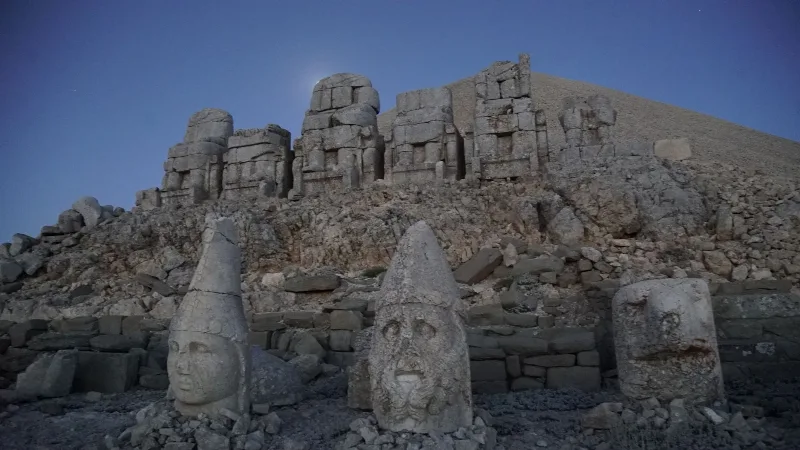
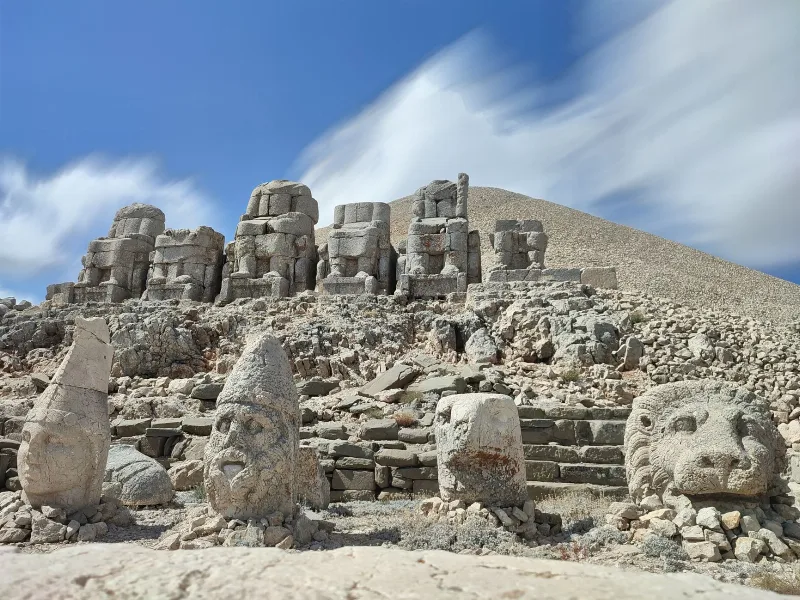
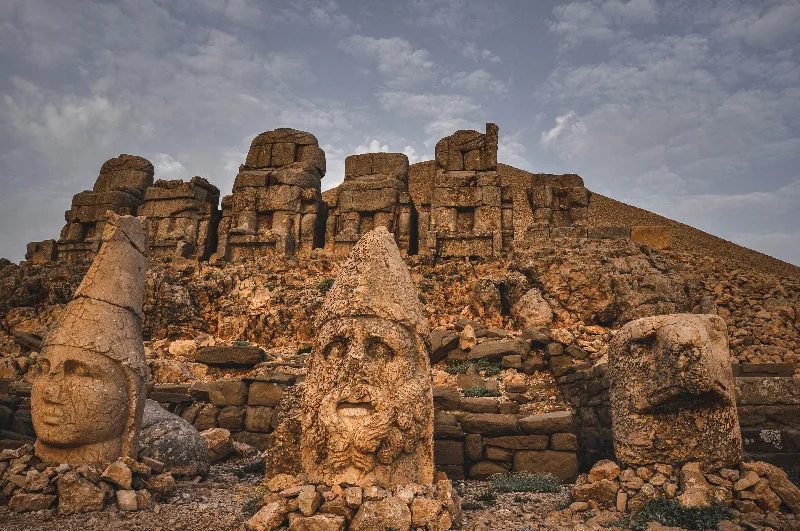
The sanctuary consists of two terraces, east and west, cut into the mountain on either side of the great mound. On both terraces stand colossal seated figures roughly eight to nine metres tall, arranged on thrones with their backs to the mound. The bodies remain in place; the heads, about two metres high, lie scattered on the terrace floors where they fell, most likely as a result of earthquakes and centuries of freezing and thawing at altitude.
Five figures are represented on each terrace, combining Greek and Persian identities:
- A Zeus figure identified with Oromasdes
- Apollo identified with Mithras, Helios and Hermes
- Heracles identified with Artagnes and Ares
- A goddess representing Commagene, comparable to Tyche
- Antiochus I himself
Guardian animals, including eagles and lions, also form part of the group. The sculpted faces combine Greek modelling with Persian dress and headgear, and the contrast is visible even in the damaged stone. On the west terrace, relief slabs show Antiochus shaking hands with each deity — the gesture of acceptance into the divine company that the whole monument was built to assert.
The lion horoscope
Among the reliefs is a well-known slab showing a lion walking beneath a crescent moon, with stars represented on and around its body. The position of the celestial bodies has been interpreted as a specific astronomical configuration and has been dated by researchers to the middle of the first century BC, which would make it one of the earliest known depictions of a horoscope. The relief is one of the most discussed objects in the study of Commagene.
The tumulus and the missing burial chamber
The centrepiece of the complex is the tumulus itself: a cone of loose crushed rock roughly 50 metres high and about 150 metres across. It is not natural. Beneath it, according to Antiochus's own inscriptions, lies his tomb.
No burial chamber has ever been found. Excavations and tunnels driven into the mound have not located a grave or a burial passage, although an unfinished tunnel cut through the bedrock suggests the work was abandoned before completion. The tomb of Antiochus therefore remains one of the open questions of Anatolian archaeology.
What you actually see when you arrive
Visitors reach a car park below the summit, then walk up a path to the terraces. The experience is not like walking through a museum: the statues sit outdoors in the open, in a rocky and wind-exposed landscape with no enclosing structure. The fallen heads are lined up near their original thrones, facing outward across the mountains.
The scale of the site is small in plan — the terraces are compact — but the setting is what gives it its character. On clear days the view extends over the ridges and valleys of the Anti-Taurus, and the artificial mound dominates everything around it.
Access, the climb and the terrain
The last stretch is a walk of roughly half a kilometre from the car park to the terraces, uphill on a stepped and gravel path. It is short but steep, and at 2,134 metres the thinner air makes it feel harder than the distance suggests. Most reasonably mobile visitors manage it in twenty to thirty minutes. There is no vehicle access to the summit itself.
There is an entrance fee at the site. Facilities are limited and concentrated near the car park, so water, food and sun protection should be arranged in advance. The ground is uneven rock and loose stone, and sturdy shoes matter more here than at most archaeological sites.
Sunrise and sunset at the summit
Nemrut is best known for the light at the beginning and end of the day. Groups commonly climb before dawn to watch the sun rise from the east terrace, when the heads are lit from behind; the west terrace serves the equivalent purpose at sunset. These are also the coldest and busiest times, and pre-dawn visitors should carry a torch or headlamp for the path.
Climate and the best period to visit
The site sits at high altitude and is subject to heavy snow. The access road can be blocked from late autumn through spring, and visits outside the warmer months may be impossible or severely restricted. The most reliable window runs from late spring to early autumn.
Even in summer, mornings and evenings at the summit are cold and windy, so layers are essential. Midday in July and August is bright and exposed, with little shade anywhere on the terraces. Snow can persist on the north-facing slopes into late spring.
Things worth knowing before you go
- The summit is exposed to strong wind and rapid weather changes; a clear day in the valley does not guarantee clear conditions above.
- There is no reliable shelter on the terraces.
- Mobile phone coverage in the area is patchy.
- Because the site is remote, visits are usually combined with other monuments in the Kahta area rather than treated as a short stop.
- The statues stand outdoors in a seismic zone, and the condition of the stone is a conservation concern rather than a static display.
Genuinely related places nearby
The Nemrut sanctuary was only one part of the Commagene royal programme, and several related monuments lie within the same district of Adıyaman:
- Arsameia on the Nymphaios, also called Eski Kale, an ancient Commagene city with rock-cut tunnels, inscriptions and a relief showing Heracles greeting King Mithridates.
- The Cendere Bridge, a Roman bridge over the Cendere stream built by a legion and dedicated to the emperor Septimius Severus, still standing with its original columns.
- The Karakuş Tumulus, a burial mound of the Commagene royal women, marked by columns topped with eagle and bull figures.
- Yeni Kale, a later fortress near the Cendere valley that was rebuilt in the medieval period on an older foundation.
- Adıyaman and Kahta, the two towns that serve as the practical bases for reaching all of these sites; the Adıyaman museum holds finds from the region.
A different Mount Nemrut
The name Nemrut is used for more than one mountain in Türkiye. A separate Mount Nemrut, a volcanic peak in Bitlis Province near Tatvan on the western shore of Lake Van, contains one of the country's largest crater lakes. That mountain has no connection with Antiochus I or the Commagene statues. Travellers searching for the colossal heads and the tomb-sanctuary need the summit in Adıyaman Province.
Related content
Mount Nemrut
Mount Nemrut in Adıyaman Province is the summit hierothesion of King Antiochus I of Commagene, where colossal statues of gods and a royal ruler stand on terraces above an artificial stone tumulus. The site is a UNESCO World Heritage property whose Greek inscriptions and reliefs record a Hellenistic kingdom of the first century BC.
Mount Nemrut
Mount Nemrut is a dormant volcano in Bitlis Province, eastern Türkiye, featuring a large caldera with crater lakes. It lies west of Lake Van near Tatvan.
Adıyaman
Explore Adıyaman, southeastern Türkiye: history, standout sights, landscapes, local food and practical travel advice for an unforgettable journey in Türkiye.
The Fascinating History of Mount Nemrut
Mount Nemrut is renowned for its ancient statues and monumental tombs, offering a glimpse into a mysterious past.
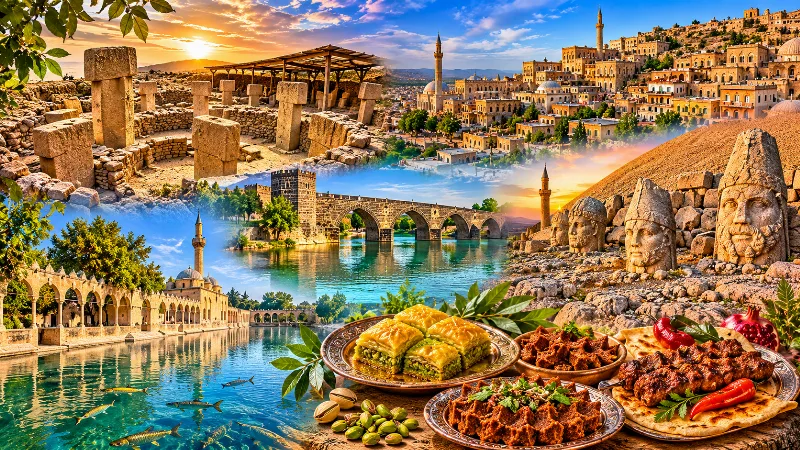
Southeastern Anatolia Region
Southeastern Anatolia is known for its ancient cities, extraordinary archaeological heritage, traditional stone architecture and rich culinary culture. From the historic streets of Mardin to the monumental landscapes of Şanlıurfa and the Euphrates River, the region reflects thousands of years of civilization.
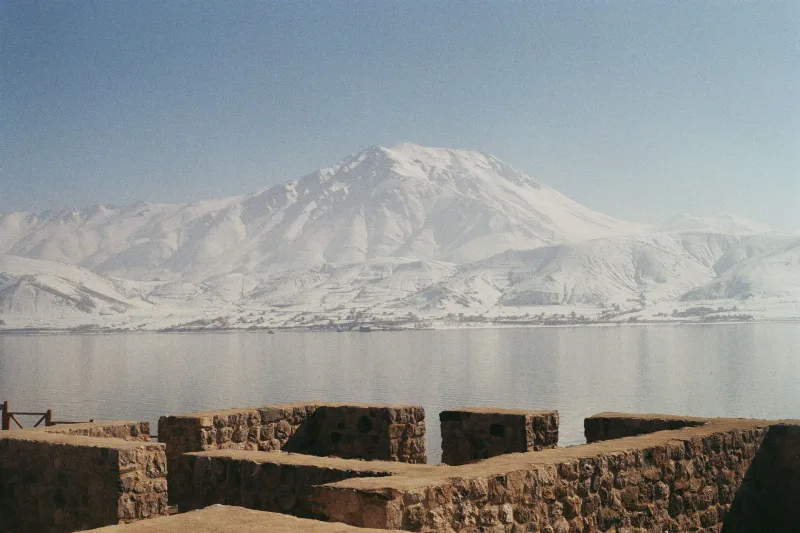
Lake Van
Lake Van is Turkey's largest lake, a vast alkaline soda lake with no outlet, set in the volcanic highlands of Eastern Anatolia at around 1,640 metres. Its unusual chemistry, depth and islands give it a character unlike any other lake in the country.