
Myra
Myra is an ancient Lycian city in the Demre district of Antalya, whose cliff-carved rock tombs and large Roman theatre stand within the modern town itself.
Myra is an ancient city on the plain of the Demre Çayı — the Myros of antiquity — in the Demre district of Antalya Province, southern Türkiye. It was one of the most powerful members of the Lycian League, and its ruins are distinctive because two very different monuments stand almost side by side inside a working town: a necropolis of Lycian rock-cut tombs carved high into a vertical cliff, and a large Roman theatre at the foot of that cliff. The ancient city and the present-day settlement of Demre occupy the same ground, so the archaeology here is interwoven with everyday streets and buildings rather than fenced off in isolation.
A City of the Lycian League
Myra was among the Lycian cities that carried three votes in the Lycian League, the federal union of Lycian communities, and its weighting reflected its size and standing. Its wealth drew on the fertility of the Myros plain and, above all, on access to the sea through its harbour at Andriake a few kilometres to the south. The city flourished through the Hellenistic and Roman periods and remained important into late antiquity, when it became a Christian bishopric. A combination of Arab raids and the gradual silting of its harbour led to its decline, and by roughly the ninth century the urban centre had been largely abandoned.
The Rock-Cut Tombs
The best-known feature of Myra is its necropolis, cut into the near-vertical rock face on the south-eastern side of the acropolis hill, above the theatre. The tombs are Lycian in style and fall broadly into two families: house-type tombs whose facades imitate timber buildings, complete with carved beams and pitched roofs, and temple-type tombs with columned porches and pediments. Many carry inscriptions in the Lycian language and in Greek. The so-called Lion Tomb, decorated with a relief of a lion, is among the oldest and most frequently photographed of the group. The tombs were deliberately placed high on the cliff, and reaching them involves climbing stairways and steep, uneven paths, so the dead were set physically above the living city below.
The Roman Theatre
At the base of the same hill stands the Roman theatre, one of the largest surviving in Lycia. It originated in the Hellenistic period and was substantially rebuilt under Roman rule; the auditorium is set against the slope, and the stage building was decorated with reliefs, some of which remain visible. The structure was damaged by an earthquake in AD 141 and repaired with the help of wealthy benefactors, a pattern seen in several Lycian cities of the period. The pairing of a monumental theatre with a cliff of tombs above it is what gives Myra its particular character.
Andriake, the Harbour of Myra
Myra's link to the sea was Andriake, about five kilometres to the south, near the present-day settlement of Çayağzı. The most prominent surviving structure there is a large Roman granary built during the reign of Hadrian, whose long facade still stands beside what is now a silted lagoon. Around it are the remains of harbour buildings, cisterns and shops, and the site also preserves the remains of a synagogue. Andriake shows clearly how the same river that gave Myra its farmland also choked its harbour with sediment over the centuries.
The Church of St. Nicholas at Demre
Nicholas was bishop of Myra in the fourth century and lies behind the later Santa Claus tradition. His church, in the centre of modern Demre, was built as a basilica in the sixth century over the site of his tomb and was later modified and enlarged. It contains a sarcophagus identified as his tomb along with surviving wall paintings, although his relics were removed to Bari in Italy in 1087. The church and the ancient city are close enough to visit on the same outing.
Landscape and Setting
Myra occupies a flat, fertile plain backed by the foothills of the Taurus Mountains. The acropolis is a rocky outcrop rising from the plain, and its steep south-eastern face is what made the site suitable for monumental rock-cut tombs. The Demre Çayı still crosses the plain today. The climate is Mediterranean, with hot, dry summers and mild, wetter winters, strong sun for much of the year, and very little natural shade among the ruins.
Getting There and Moving Around
Demre lies on the D400 coastal highway between Fethiye and Antalya, close to the town of Kaş, and is served by intercity coaches and local minibuses. The theatre and the rock-cut tombs are within the town itself, while the Church of St. Nicholas is a short walk away, so the principal monuments can be seen on foot. The climb to the tombs involves steps and walking over uneven, sometimes loose surfaces; there is no step-free route to the higher tombs, and sturdy shoes are advisable. Visitors with limited mobility can still see the theatre, the lower parts of the site and the interior of the church more comfortably.
When to Visit
Spring, roughly April to May, and autumn, around September to October, offer the most comfortable conditions, with warm but manageable temperatures. Midsummer can be very hot, especially on the exposed rock, so early morning is the better choice at that time of year. Winter is mild and quieter but wetter, and the stone paths and stairs can be slippery after rain.
Things to Know Before You Go
- The monuments form part of a working town rather than an isolated archaeological park, so expect the ruins to be interwoven with streets and buildings.
- There is very little shade at the tombs and the theatre; carry water and sun protection.
- Rock surfaces and stairways can be slippery, particularly after rain, so take care on the climb.
- The tombs, the theatre and the Church of St. Nicholas are separate areas within the town, so plan a little time to move between them.
Related Places Nearby
The wider Demre area holds several places that pair naturally with a visit to Myra. The sunken ruins of Kekova lie just offshore, usually seen by boat from the villages of Üçağız and Kaleköy, where the small castle of Simena stands above the water. The coastal town of Kaş, a short drive west, is a base for exploring this stretch of the coast. The Lycian Way, a long-distance walking trail, passes through the region. Further west along the coast are the Lycian sites of Patara and Xanthos, while to the east lie Olympos and Çıralı, giving the area a dense concentration of Lycian and Roman remains.
Related content
Antalya
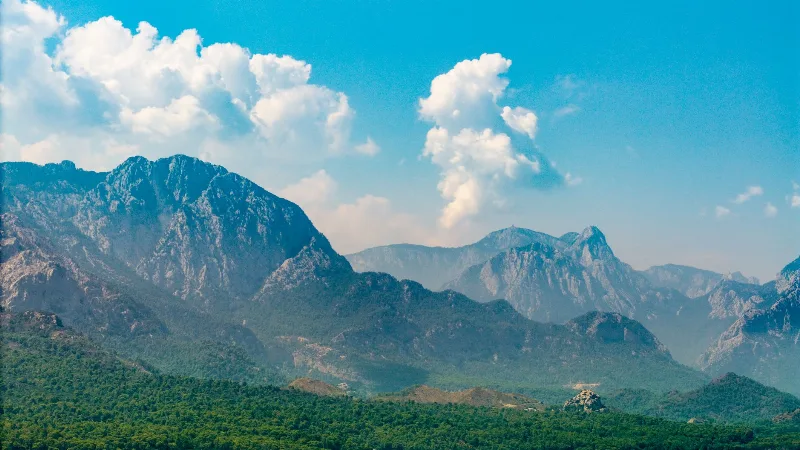
Antalya offers a unique blend of vibrant history and stunning natural beauty, making it a must-visit destination in Türkiye.
Fethiye
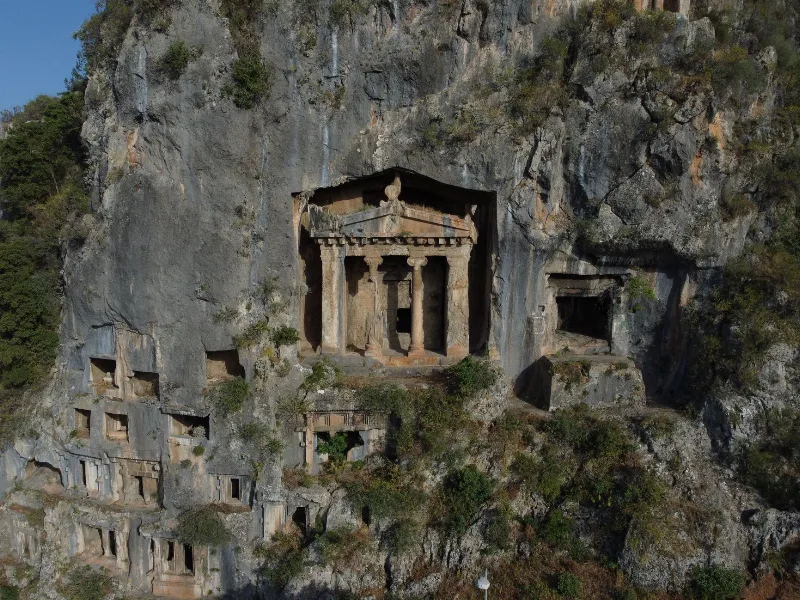
Fethiye is a captivating coastal town known for its stunning blue lagoon, thrilling paragliding experiences, and ancient rock tombs.
Patara
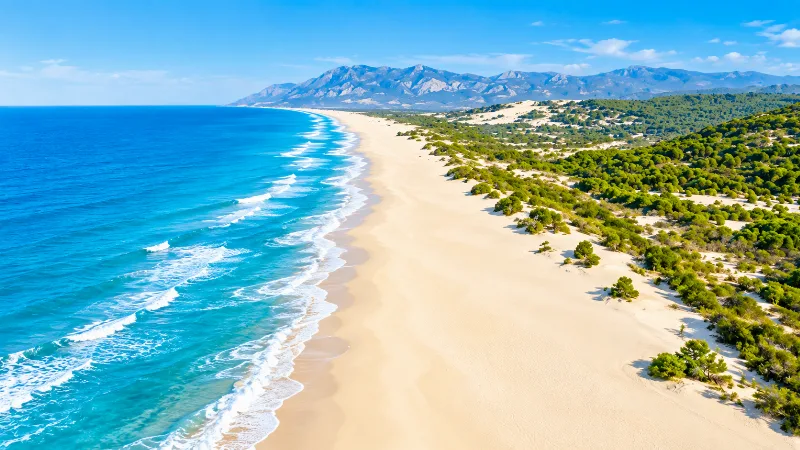
Patara is a long, wide sandy beach on Türkiye's Lycian coast, backed by dunes and a shallow wetland, where the open Mediterranean meets a protected coastal landscape.
5-Day Antalya to Fethiye Coastal Route
A five-day driving itinerary along Turkey's Mediterranean shore, linking Antalya, Phaselis, Olympos, Demre, Kekova, Kaş, Kalkan, Patara and Fethiye. The route is linear, coastal for most of its length, with short inland detours to Lycian ruins.
6-Day Mediterranean Coast Route: Antalya to Marmaris
A six-day linear route along Türkiye's Mediterranean coast, linking Antalya, Olympos, Demre, Kekova, Kaş, Kalkan, Patara, Fethiye and Dalyan before finishing in Marmaris. It mixes ancient cities, long beaches and small harbour towns on a continuous westward drive.
4-Day Lycian Coast Route
A four-day route along Turkey's Lycian coast, driving from Fethiye and Ölüdeniz through Kalkan, Kaş, Kekova, Demre and Olympos to finish in Antalya.