
Uzungöl
Uzungöl is a highland village in Trabzon's Çaykara district, wrapped around a dark mountain lake held back by a landslide dam and surrounded by dense Black Sea forest.
Uzungöl is a highland village in the Çaykara district of Trabzon Province, in the Eastern Black Sea region of Türkiye. Its name means “long lake”, and the settlement is arranged around a dark, narrow body of water that formed when a landslide blocked a mountain stream. What sets Uzungöl apart from most villages in the region is the way the lake, the steep forested slopes and a small mosque standing directly on the shoreline all sit within a few minutes’ walk of one another, so the whole place can be understood on foot in a single visit.
Where Uzungöl Is and How the Lake Came to Be
The village lies high above the coast, in the mountains that rise inland from Trabzon, at an elevation of roughly 1,090 metres. It occupies the floor of a valley that runs between steep, wooded ridges. The lake itself was not made by people: a landslide blocked the Haldizen stream, damming the valley and letting water collect behind the debris. The result is a long, narrow strip of water, roughly a kilometre from end to end and only a few hundred metres across, fed by streams and by the very heavy rainfall that this part of the Black Sea coast receives. Because the lake and its immediate surroundings are protected as a nature park, the shoreline and the forest around it have remained largely green, and the valley keeps a cool, damp atmosphere even in the middle of summer.
A Village Shaped by Water and Weather
Uzungöl is a village rather than a resort, although tourism has become its main activity. The built area is spread around the lake and up the lower slopes, with the road running along one side of the water. Older local houses were built with timber frames over stone foundations and steep, pitched roofs designed to shed the region’s constant rain and heavy winter snow. Wooden balconies and overhanging upper floors are part of that tradition, and the deep eaves keep water away from the walls. In recent decades many newer buildings have appeared in a distinct chalet style, with exposed wood and wide windows facing the lake, so the village now shows two architectural layers side by side: the older Black Sea village house and the newer timber guesthouse form. Walking through the streets, this mix is one of the most noticeable features of Uzungöl.
The Mosque on the Shore
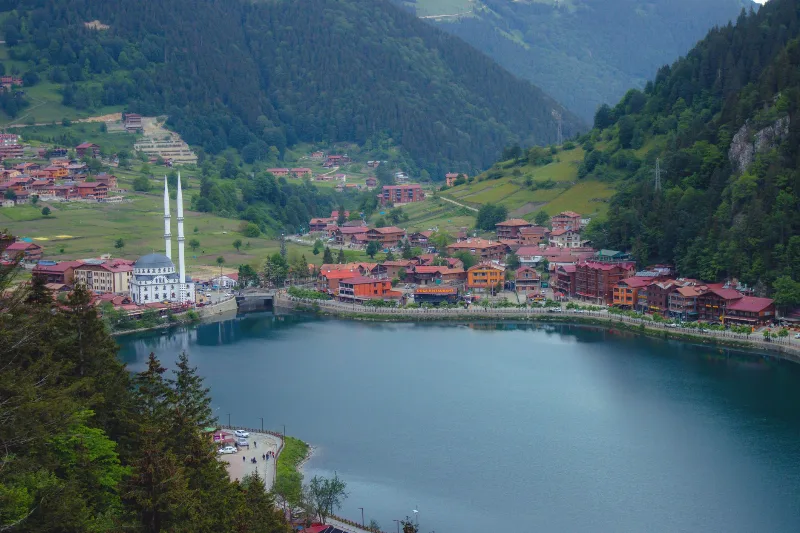
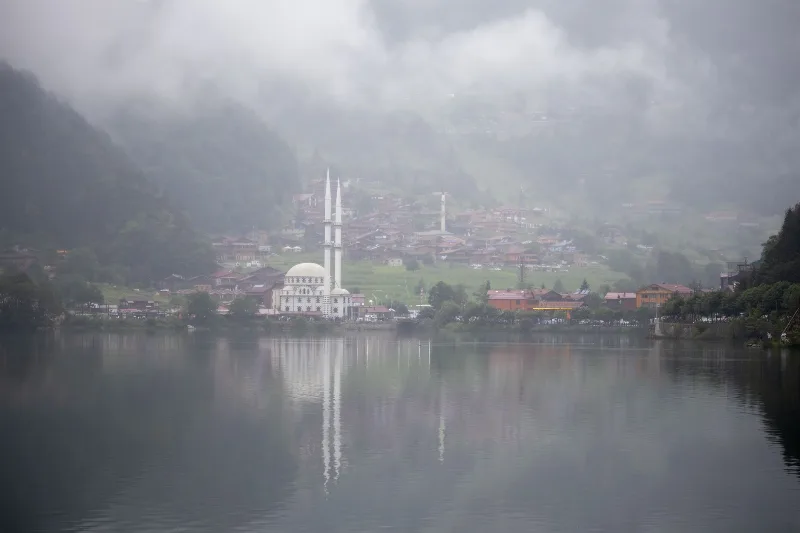
The most photographed structure in Uzungöl is the mosque that stands close to the water. It is a compact building with a central dome and a single slender minaret, finished in pale plaster, and it is visible from much of the lake because the shoreline around it is open. Its position, at the point where the village meets the lake, makes it the visual anchor of the settlement and the clearest single landmark for a visitor trying to orient themselves. Around it, the ground is level enough to walk comfortably along the edge of the water.
Forest, Mountains and the Yayla Tradition
Uzungöl sits inside the highland belt that defines the Eastern Black Sea mountains. Dense stands of spruce and beech cover the slopes, mixed with alder and other moisture-loving trees along the streams. This is genuine temperate rainforest country: the ridges above the village are frequently wrapped in cloud, and mist drifting over the water is a normal part of the local weather rather than an occasional event. The wider area is also part of Türkiye’s yayla, or highland pasture, culture. For generations, families moved with their livestock from the lower valleys to summer pastures higher in the mountains, and that seasonal movement shaped settlement patterns across Çaykara. Higher up, reached by mountain roads, are summer plateaus such as Sultan Murat Yaylası, where the pasture landscape and the traditional highland way of life can still be seen in season.
Local History and Community
The Çaykara area has a long and layered history connected to the valleys behind Trabzon. The wider district is known for a Greek-derived dialect that some older residents still speak alongside Turkish, a reminder of how mixed and old the communities of these valleys are. In the twentieth century, emigration changed Uzungöl profoundly: many families left for Germany and other parts of Europe, and the money they sent home helped rebuild houses and reshape the village. From the later twentieth century onward, visitors began to arrive in growing numbers, and the local economy gradually shifted from farming and livestock toward hosting travellers. That shift is visible in the village’s appearance today, but the surrounding pastures and forests still belong to the older agricultural world.
What You Can Realistically See on Foot
The core of Uzungöl is small enough to explore without a vehicle. The main experience is a walk along the lakeshore, where the water, the forested slopes and the mosque can all be taken in from close range. Paths and minor roads lead a short way into the surrounding woods, and the terrain near the lake is mostly gentle, though the side valleys and higher slopes become steep quickly. Because the village is compact, a few hours are enough to cover the central area, while a full day allows time to sit by the water, follow the shoreline in both directions and walk a little way up toward the surrounding hills for a wider view of the valley. The weather changes fast here, so waterproof clothing and shoes with grip are more useful than formal footwear.
Getting to Uzungöl
Trabzon is the main gateway. The city has an airport, and from there the village is reached by road, a drive of roughly two hours that passes through Of and Çaykara and then follows the Solaklı valley inland and upward. The final stretch climbs through the valley and gives a clear sense of leaving the coast behind and entering the highlands. Public buses and minibuses connect Trabzon with Uzungöl, and the route is also commonly driven by car. In winter, snow and ice can affect the higher sections of the road, so conditions are worth checking before setting out in the colder months.
When to Visit and What to Know
Summer, from roughly June to September, is the mildest and greenest period, and it is also the busiest. Early autumn brings changing colours on the slopes and a quieter atmosphere, often with mist over the lake. Winter transforms the valley under heavy snow and gives the village a very different character, but temperatures drop and travel can be more difficult. Spring is wet and green, with frequent rain. Rainfall is possible in every month, so visitors should expect damp conditions and dress accordingly. The altitude means temperatures are noticeably cooler than on the Trabzon coast, and evenings by the lake can feel cold even in summer. Because the settlement is small and popular, the central shoreline is at its most crowded in high season, while the surrounding forest and the road up toward the highland pastures remain far quieter. Uzungöl is best understood as a mountain village first and a busy visitor destination second, and that balance is easiest to feel early in the morning or outside the peak weeks.
From the land
Find All →
Kahramanmaraş Peppers
Kahramanmaraş peppers are the red peppers grown on the inland plains of southern Türkiye, where hot, dry summers and fertile soils give the crop its deep colour, moderate heat and smoky aroma.
Explore →
İpsala Rice
Grown on the river-fed alluvial plain around İpsala in Edirne province, İpsala rice reflects the landscape of Thrace: flooded paddies, warm summers and a long local milling tradition.
Explore →
Aydın Figs
Aydın figs are the dried figs of Türkiye's Aegean interior, grown in the valleys around the Büyük Menderes River and prized for their sweetness, soft texture and pale amber colour.
Explore →Related content
Trabzon
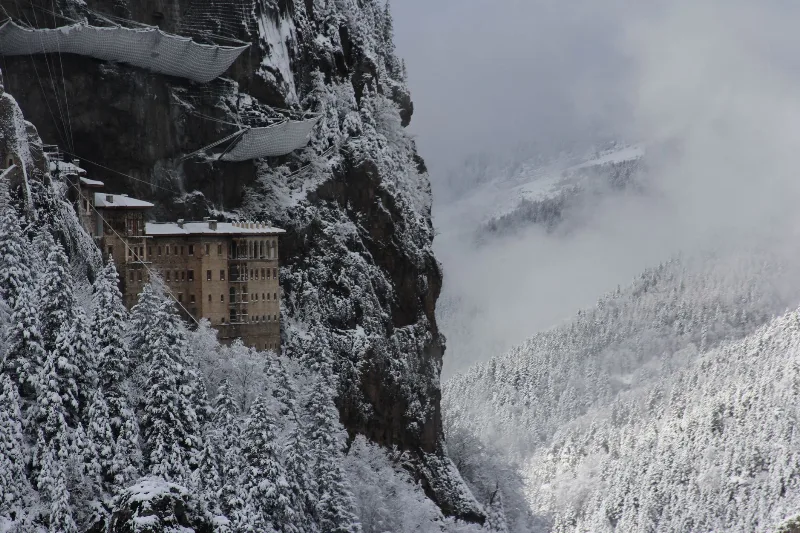
Trabzon is a rain-washed port city on Türkiye's eastern Black Sea coast, framed by the cliffside Sumela Monastery and slopes of tea. Byzantine and Ottoman layers sit close to highland valleys just inland.
3-Day Trabzon and Uzungöl Route
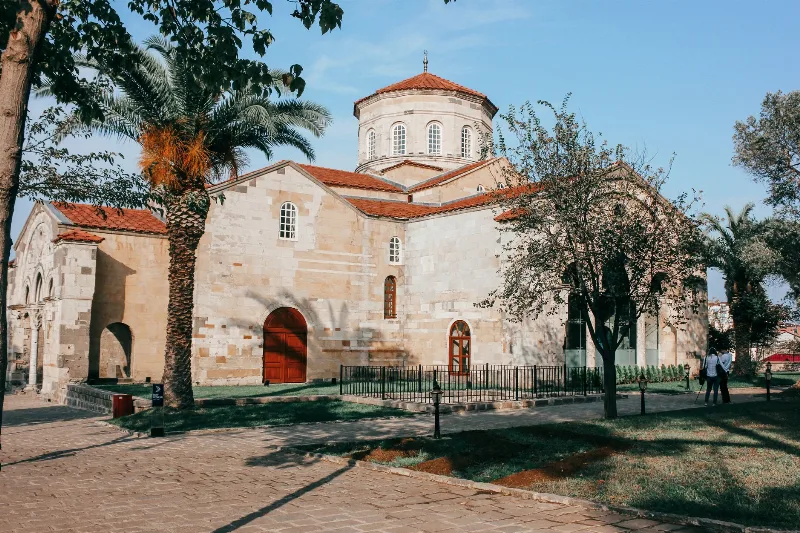
This 3-day route in Türkiye's Eastern Black Sea region starts and ends in Trabzon, visiting Hagia Sophia, Sümela Monastery, and Uzungöl Lake. It blends city sightseeing, mountain driving, and lakeside relaxation.
Lake Uzungöl
Lake Uzungöl is a landslide-dammed lake in Çaykara district, Trabzon Province, sitting on the floor of a steep, forested valley in Türkiye's Black Sea region.
5-Day Eastern Black Sea Route
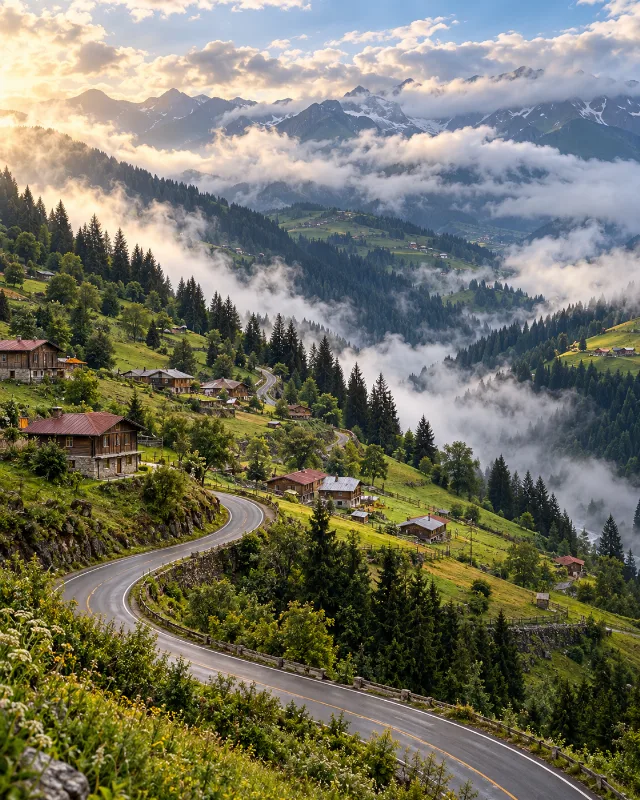
A five-day journey from Trabzon through Uzungöl, Rize, Çamlıhemşin, Ayder, Borçka and Şavşat, combining Black Sea culture with forests, lakes and highlands.
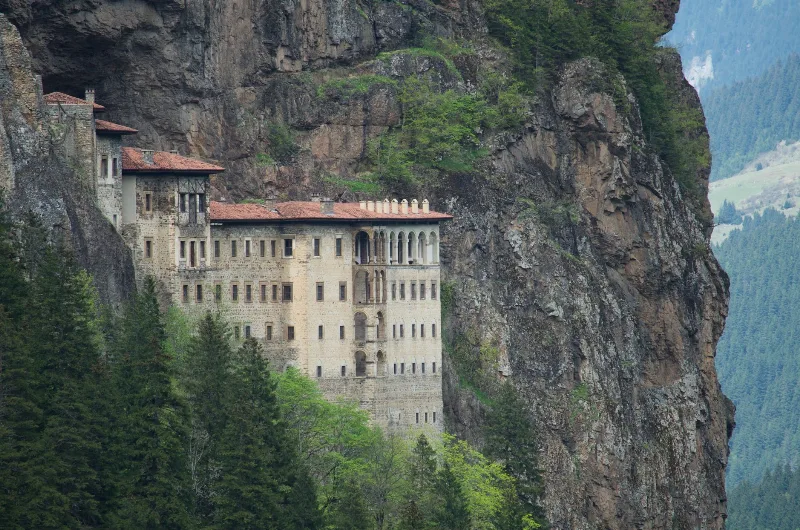
7-Day Eastern Black Sea Highlands Route: Trabzon to Artvin
A seven-day driving route through the Eastern Black Sea highlands, from Trabzon and Sumela to Uzungöl, Ayder, the Kaçkar Mountains and the forests of Şavşat, ending at Artvin.
Uzungöl and Surrounding Nature
Uzungöl is a forest-fringed mountain lake in Trabzon province, where the green highlands of Türkiye's Black Sea region meet mist, timber villages and quiet valleys.