
Antalya Tomatoes
Antalya tomatoes are the greenhouse and field-grown tomatoes of Türkiye's Mediterranean coast, produced in a province whose mild winters and long sunny summers allow harvesting in almost every month of the year.
Antalya tomatoes are the tomatoes grown in Antalya Province on Türkiye's southern Mediterranean coast, the country's leading centre of greenhouse vegetable cultivation. The province's mild winters and long, bright summers allow growers to harvest tomatoes far beyond the short open-field season of cooler regions, and it is this year-round capacity that has tied Antalya's name to tomatoes sold throughout Türkiye and shipped to European markets in winter and early spring.
Where Antalya Tomatoes Are Grown
Tomato growing is concentrated on the narrow coastal plain that runs between the Mediterranean Sea and the Taurus Mountains. The plain stretches roughly from Gazipaşa and Alanya in the east through Manavgat, Serik, Aksu and the city of Antalya itself, then westward through Kemer, Kumluca, Finike and Demre towards the provincial border with Muğla.
Within this belt, several districts are especially associated with vegetable production. Kumluca and Demre are long-established greenhouse districts in the west of the province, while Serik and the Aksu plain near Antalya hold large areas of covered cultivation. Gazipaşa forms a second cluster in the east. Field-grown tomatoes, often intended for processing, are found on the broader, flatter parts of the plain where land is not occupied by structures.
Why the Local Climate and Geography Suit the Crop
Antalya has a classic Mediterranean climate: hot, dry summers, mild and rainy winters, and frost that is rare on the coastal strip. This combination is decisive for tomatoes, which are sensitive to cold and stop setting fruit when temperatures fall too low.
Greenhouses turn that mild winter into an advantage. A plastic or glass structure traps daytime solar heat and keeps rain off the plants, so tomato vines can keep flowering and ripening through the coolest months while open-field producers elsewhere are still waiting for spring. The sea moderates night temperatures along the coast, and the Taurus Mountains rising behind the plain shelter the growing areas from cold continental air moving down from the interior.
Soils on the coastal plain are mostly alluvial and sandy-loam, often calcareous, free-draining and easy to work, which suits the intensive drip irrigation and fertigation systems used in modern greenhouses. Because the same plots are cropped repeatedly, growers rely heavily on irrigation management, grafting and soil replacement rather than on natural soil fertility alone.
The Tomato Plant and Its Growing Cycle
The tomato, Solanum lycopersicum, belongs to the nightshade family and is a herbaceous plant rather than a tree or shrub. In Antalya's greenhouses, vines are trained upward on twine and can reach two metres or more, with trusses of fruit developing at intervals along the stem. The crop arrived in Anatolia relatively late, spreading through the Ottoman lands during the nineteenth and early twentieth centuries, and only became a staple of local cooking after that.
Greenhouse production is staggered so that harvesting does not fall in a single short window. Seed is sown in nurseries in late summer and early autumn, young plants are transplanted into the structure in autumn, and the first fruit ripens in winter. Because the plants are indeterminate, they continue to produce new trusses over many months as long as temperatures are maintained. Pollination in enclosed greenhouses is often assisted, either by managed bumblebee colonies or by mechanical vibration of the flower trusses.
Field tomatoes follow a different rhythm. They are transplanted to open ground in spring once the risk of cold nights has passed and are harvested from midsummer into early autumn.
Greenhouse and Field Tomatoes
The two systems produce noticeably different fruit. Greenhouse tomatoes are picked mainly for the fresh market and are handled carefully to protect appearance; truss or cluster tomatoes, sold still attached to the stem, are a familiar sight in Turkish markets. Field tomatoes tend to be softer, more irregular and more strongly flavoured, and a large share goes to processing.
Harvest Through the Seasons
The essential feature of Antalya production is that harvest is not limited to one season. Covered crops yield from roughly December through spring, with peak volumes in late winter and early spring, while open-field fruit fills the summer months. After picking, tomatoes are graded by size and colour, cooled, and packed for transport. Refrigerated lorries carry fresh tomatoes from the Antalya plain to domestic wholesale markets and to export destinations, and the province's road links and airport support this trade.
How Antalya Tomatoes Are Used
Most of the crop is eaten fresh. Tomatoes appear sliced in breakfast spreads, chopped into salads, stuffed, grilled, or cooked down into sauces that accompany vegetables, legumes and meat dishes. Softer field fruit is commonly turned into tomato paste and preserved tomato products, a traditional household practice across southern Türkiye. The distinction matters: the raw tomato is the agricultural product, while paste and cooked sauces are preparations made from it.
Tomatoes and the Antalya Landscape
Greenhouse cultivation has reshaped the coastal plain. White-roofed structures now form a continuous band along parts of the coast, especially around Kumluca, Demre and Serik, and the rhythm of the year in these districts is set by sowing, training, pollination and picking rather than by the grain calendar of the interior. Vegetable growing, with tomatoes among its most important crops, is a central part of the province's agricultural economy and a major source of seasonal employment.
Antalya is not the only place in Türkiye where tomatoes are grown; the crop is cultivated widely, including in the neighbouring Mediterranean provinces of Muğla and Mersin and in the Aegean region around İzmir. What sets Antalya apart is the scale and concentration of protected cultivation on its coastal plain, and the resulting ability to supply fresh tomatoes in the months when most of the country cannot produce them outdoors.
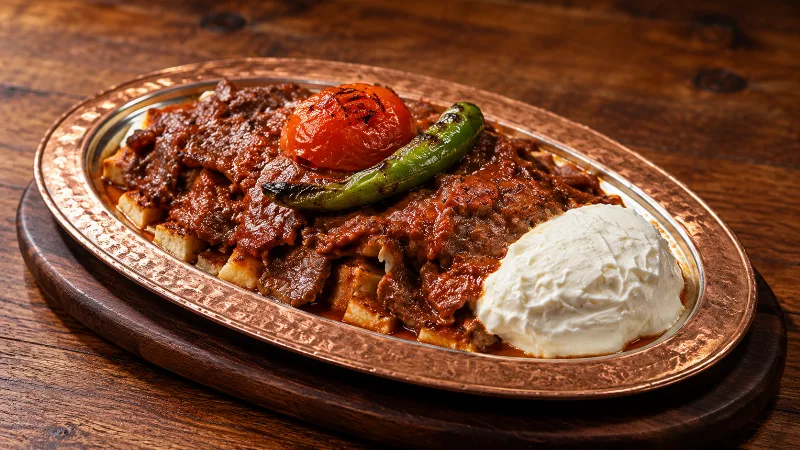
İskender Kebabı
A Bursa specialty made with thin slices of döner served over pide bread with tomato sauce, butter and yogurt.
Explore →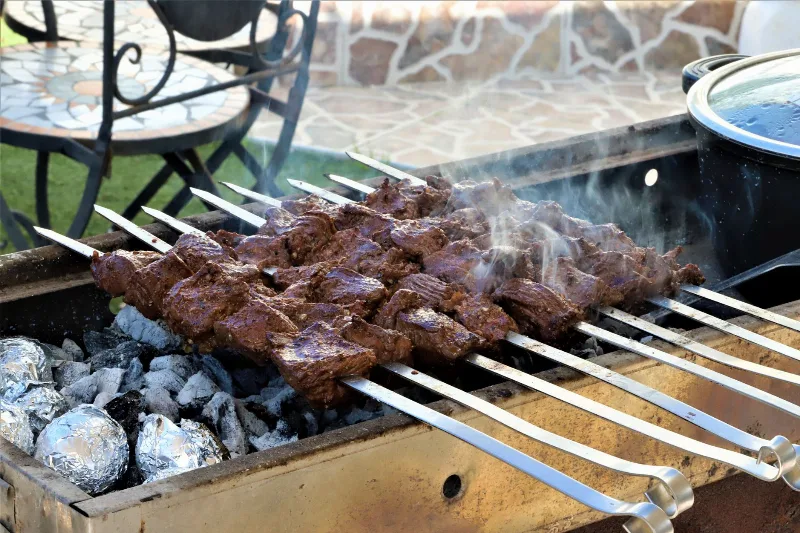
Urfa Kebabı
Urfa Kebabı is a charcoal-grilled minced lamb kebab from Şanlıurfa, seasoned without hot pepper and pressed onto long flat skewers. Its mild, juicy character places it alongside — and directly against — the spicier Adana kebabı.
Explore →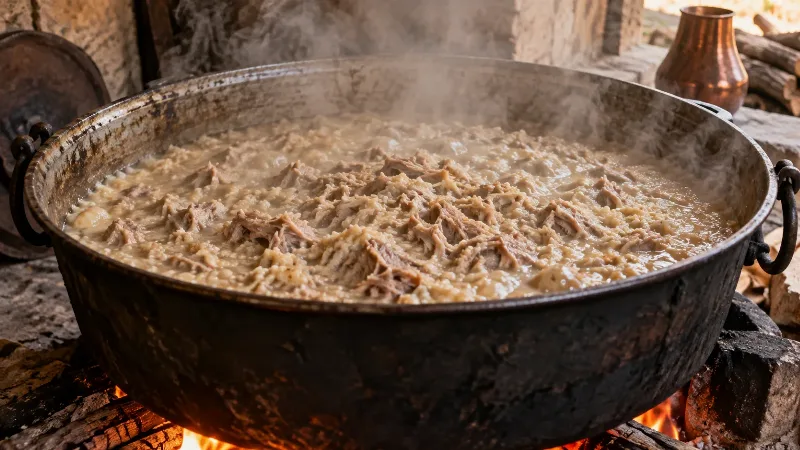
Keşkek
Keşkek is a traditional Anatolian dish made by cooking hulled whole wheat together with meat and pounding the softened mixture into a thick, dense mass. It is best known as a communal celebration food, especially at weddings.
Explore →Related content
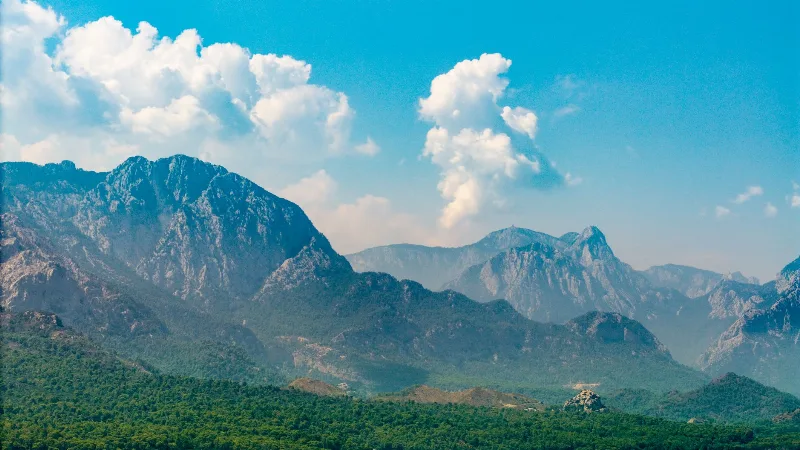
Antalya
Antalya offers a unique blend of vibrant history and stunning natural beauty, making it a must-visit destination in Türkiye.

Alanya
Alanya is a district and coastal city in eastern Antalya Province, Türkiye, built around a Seljuk fortress peninsula that carries the Red Tower, a medieval shipyard and an inhabited old town. Long beaches, a mountain backdrop and a long warm season shape its character.

Kemer
Kemer is a coastal district of Antalya Province on Türkiye's Mediterranean shore, known for its yacht marina, pebbly beaches and its position between the Beydağları mountains and ancient Lycian sites such as Phaselis.
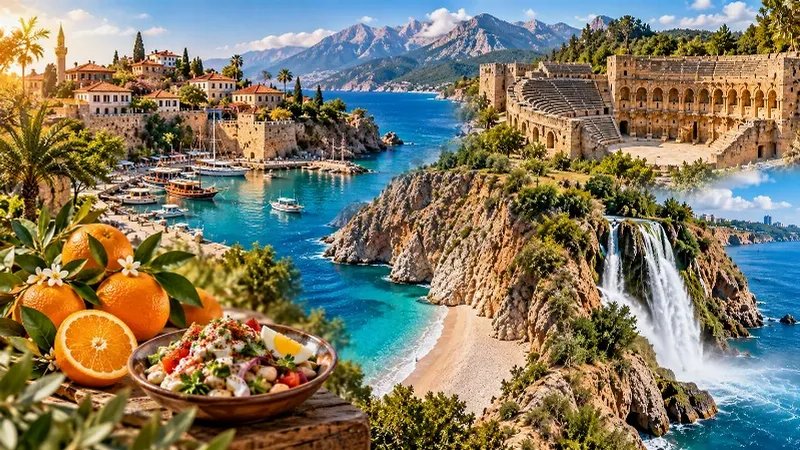
Mediterranean Region
Türkiye's Mediterranean Region combines turquoise coastlines, dramatic mountains, ancient cities and fertile landscapes. From Antalya's beautiful beaches to the historic settlements of the eastern Mediterranean, the region offers a rich blend of natural scenery, cultural heritage and traditional local life.
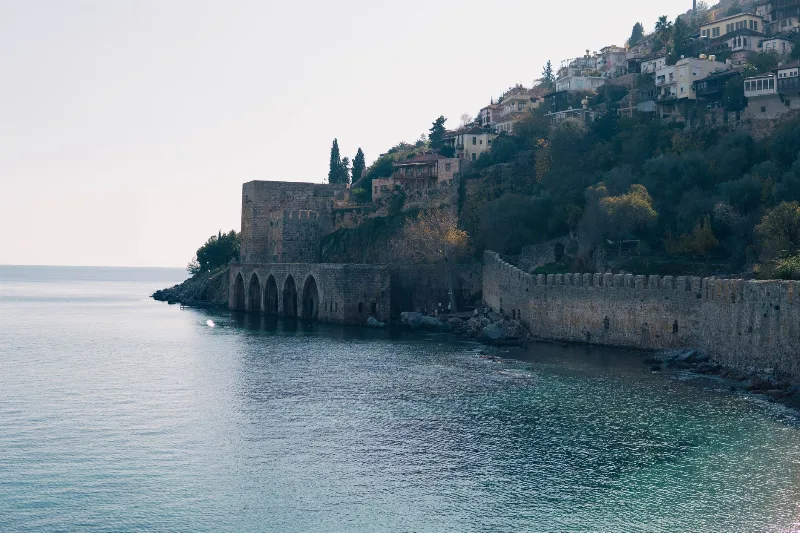
Alanya Castle
Alanya Castle is a 13th-century Seljuk fortress spread across a rocky peninsula above the Mediterranean in Antalya Province, Turkey. Its walls, towers and hilltop citadel form one of the most complete surviving Seljuk defensive complexes in Anatolia.
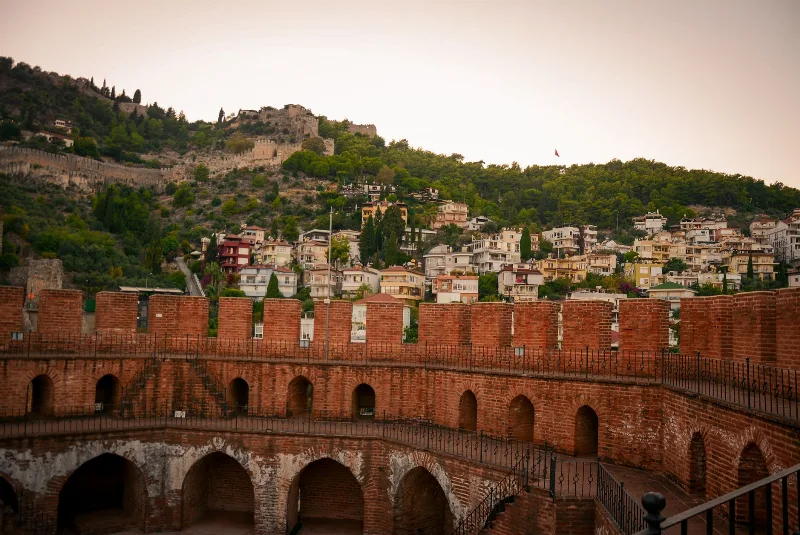
Alanya Castle
Alanya Castle is a medieval fortress on a rocky Mediterranean promontory in Antalya Province, Türkiye, whose surviving defences were largely built under the Seljuk Sultanate of Rum in the 13th century. Its walls, inner citadel, Red Tower and vaulted shipyard form one of the most complete Seljuk military and maritime complexes in Anatolia.