
The Natural Wonders of Pamukkale
Pamukkale in Denizli, Türkiye, is a hillside of white travertine terraces and warm mineral springs that has been shaped by geology for millennia.
Pamukkale, whose name means "cotton castle" in Turkish, is a natural formation in Denizli province in western Türkiye. Here, mineral-rich thermal water has been flowing down a hillside for thousands of years, depositing layer upon layer of white calcium carbonate and creating a series of terraced pools that glow in shades of pale blue and turquoise. The site sits directly above the ruins of the ancient city of Hierapolis, so one landscape holds both remarkable geology and a long record of human settlement.
How the Travertine Terraces Formed
The terraces are made of travertine, a soft sedimentary rock produced when calcium-rich spring water reaches the open air. As the water emerges, carbon dioxide escapes and dissolved calcium carbonate settles out of solution, gradually building the rounded edges and shallow basins that step down the slope toward the plain. This process is slow and continuous, and the surface remains delicate: the deposits are easily broken, which is why walking routes are marked and footwear is removed on the terraces themselves. From a distance the hillside can look like a snowfield or a frozen waterfall, an effect that led to the Turkish name Pamukkale and to its long use as a landmark for travellers crossing the region.
The Thermal Springs of Pamukkale
Several springs feed the site, with water that stays warm throughout the year, generally in the mid-thirties Celsius. The water carries calcium, magnesium, bicarbonate and sulphate, and it has been used for bathing since antiquity. Within the ruins of Hierapolis, an ancient pool fed by the same springs was used in Roman and Byzantine times, and the thermal character of the area has shaped settlement here for more than two thousand years. The springs also support small wetlands and patches of vegetation along the lower slope, where the warm water meets cooler ground.
Hierapolis and Its Monuments
Above the terraces stand the remains of Hierapolis, a city founded in the second century BC and later developed under Roman and Byzantine rule. Among its monuments are a large hillside theatre, an extensive necropolis with tombs of many types, the Temple of Apollo, the Plutonium, a sacred cave linked in antiquity to the god Pluto, and long colonnaded streets lined with gates and public buildings. Baths, fountains and a gymnasium complex show how the city was organised around water. Hierapolis and Pamukkale were inscribed together on the UNESCO World Heritage List in 1988 as a mixed cultural and natural site, and a museum on site displays sculpture, sarcophagi and smaller finds from the excavations.
The Surrounding Landscape
The terraces look out over the broad plain around Denizli, a working agricultural region of fields, orchards and small settlements. Not far away, the village of Karahayıt is known for springs coloured reddish-brown by iron oxide, a striking contrast to the white travertine nearby. The whole area lies in a geologically active zone, where fault lines allow deep groundwater to rise heated to the surface, connecting the thermal springs to the wider tectonic structure of western Anatolia.
Seasons and Setting
Spring and autumn bring milder temperatures and softer light, while summer afternoons can be hot and very bright on the exposed white rock. In winter, snow occasionally settles on the terraces, briefly turning the pools into a different kind of landscape. The site can be reached from the city of Denizli, which is also a gateway to other ancient cities and natural areas in the region.
Caring for a Natural Wonder
The terraces were damaged in the twentieth century when buildings were constructed on the plateau and water was diverted, reducing the flow that keeps the travertine alive. After the World Heritage listing, the structures were removed and the water supply was managed so that the pools could recover. Today conservation work continues, and the site is protected as both a geological formation and an archaeological zone. Following the marked paths, staying out of closed basins and keeping soap, oils and sunscreen away from the water all help to preserve the delicate surface for the future.
Related content
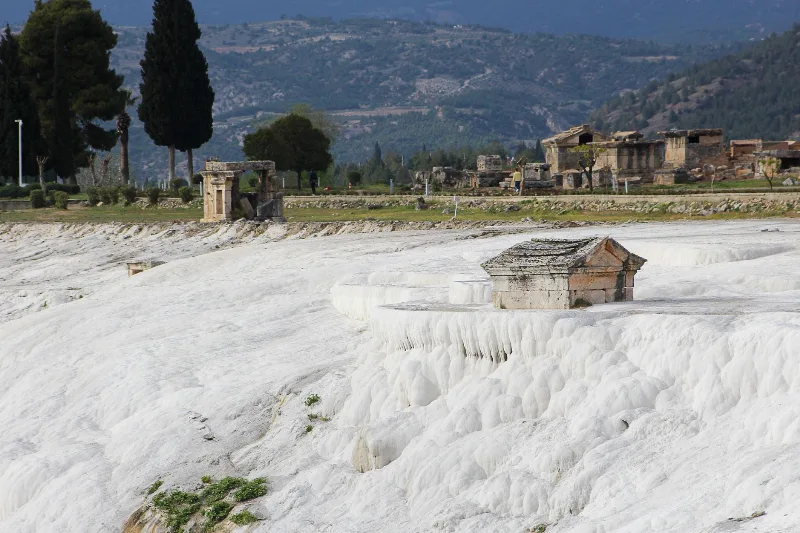
Pamukkale
Pamukkale, Türkiye'nin en etkileyici doğal harikalarından biri olarak bilinir, büyüleyici beyaz termal terasları ve antik Hierapolis kentiyle dikkat çeker.
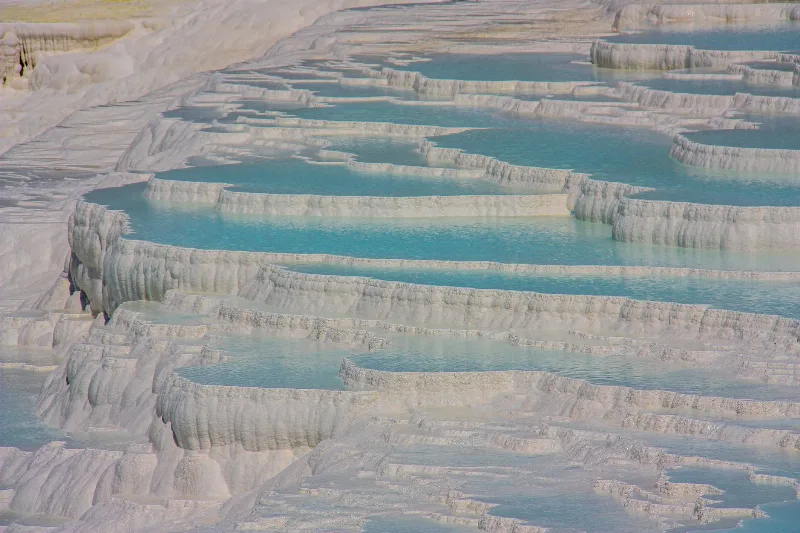
Pamukkale
Pamukkale in Denizli province is a UNESCO World Heritage site where calcium-rich thermal water has built a cliff of white travertine terraces above the ancient city of Hierapolis. Visitors walk barefoot across the terraces, while the plateau above holds Roman baths, a theatre, the Plutonium and one of Anatolia's largest necropolises.
Pamukkale
Pamukkale is a white travertine formation in Denizli Province, built up over millennia by calcium-rich thermal springs that flow down the edge of a plateau beside the ancient city of Hierapolis.
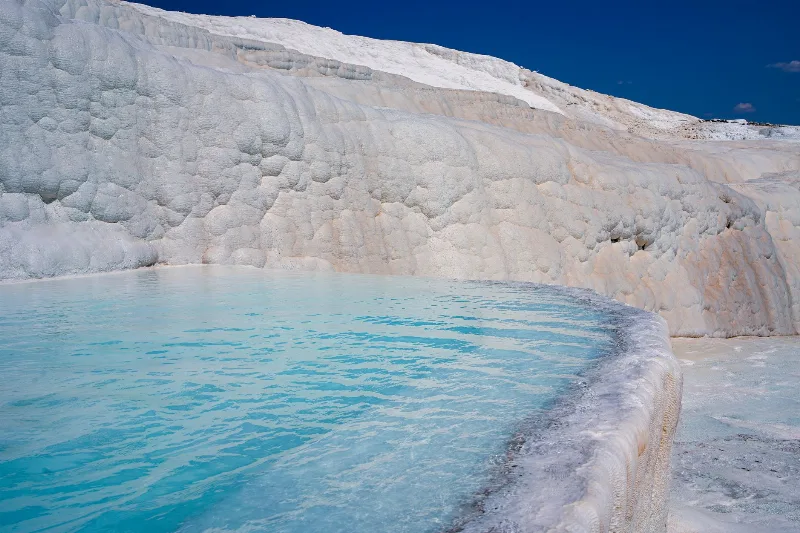
Exploring the Beauty of Pamukkale's Terraces
Discover the unique geological formations and thermal springs of Pamukkale, a remarkable natural wonder in Türkiye.
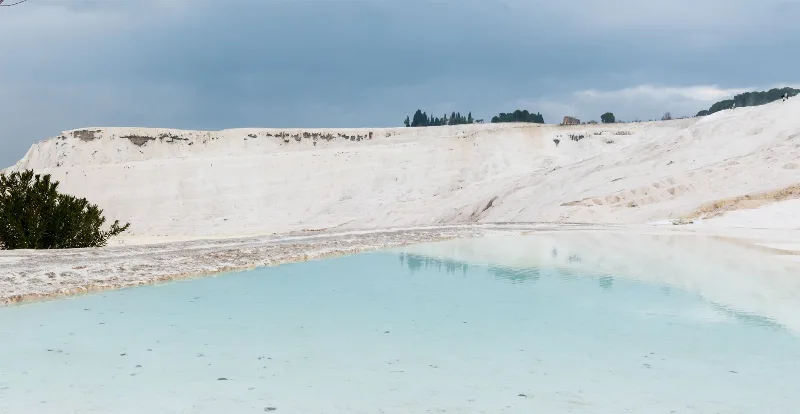
Pamukkale Travertines
Discover the mesmerizing beauty of Pamukkale's travertine terraces and thermal waters, a unique natural wonder in Türkiye.
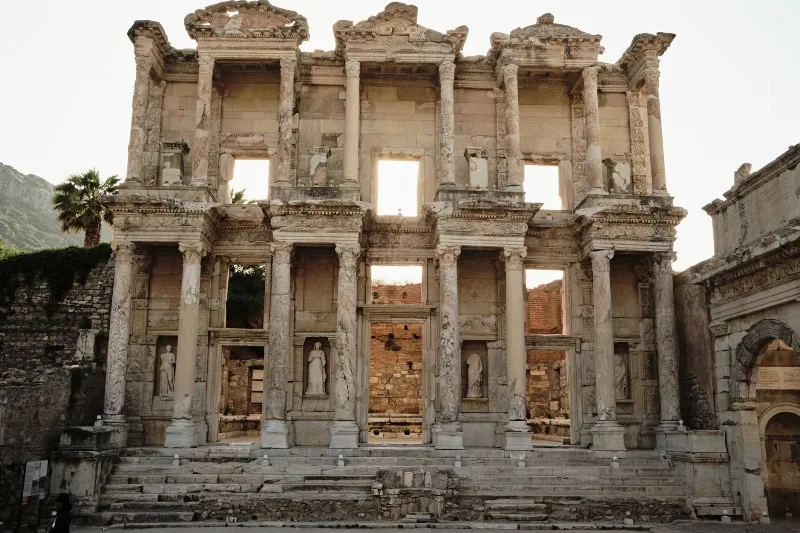
4-Day Ephesus and Pamukkale Route
A four-day west-to-east Aegean route that links the ancient city of Ephesus and the House of Virgin Mary in Selçuk with the white travertine terraces and Hierapolis ruins at Pamukkale, near Denizli.
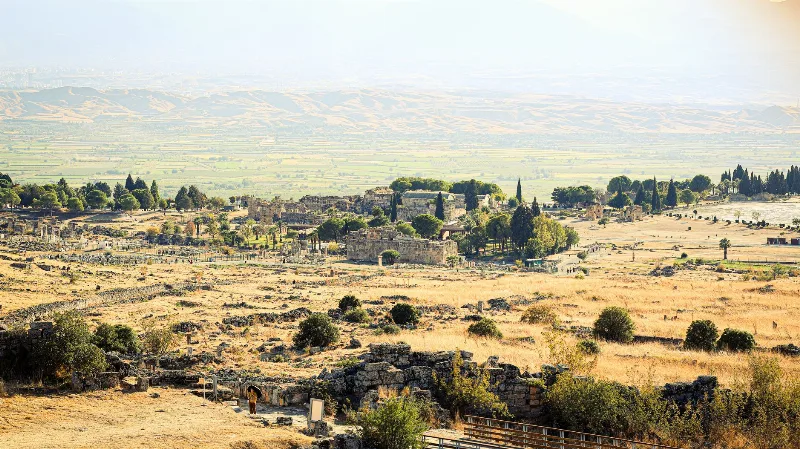
Denizli
Denizli is the inland capital of Denizli Province in Türkiye's Aegean region, known internationally for the Pamukkale travertine terraces and ancient Hierapolis, and at home as a major textile city with its own long-crowing rooster breed.
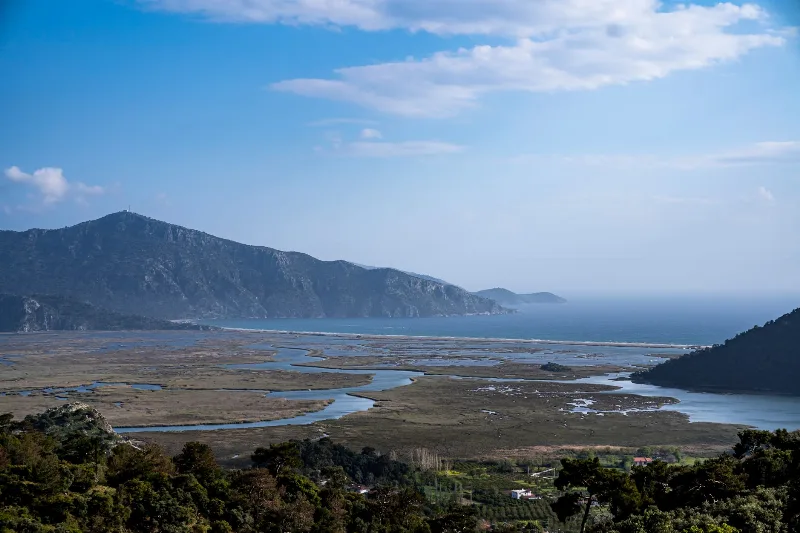
Muğla
Muğla is a captivating province in southwestern Türkiye, renowned for its stunning Aegean coastline and rich cultural heritage.