
Ephesus
Ephesus is an ancient Greek and Roman city near Selçuk in İzmir Province, Türkiye, whose ruins include the Library of Celsus, the Great Theatre and the remains of the Temple of Artemis.
Ephesus is an ancient Greek and Roman city on the Aegean side of western Anatolia, in what is now İzmir Province, Türkiye. Its excavated ruins lie in the Kaystros river valley about three kilometres from the modern town of Selçuk and roughly eighty kilometres south of İzmir. Founded by Ionian Greek settlers and later rebuilt and expanded under Roman rule, Ephesus became one of the largest and wealthiest cities of the eastern Mediterranean, and the Temple of Artemis, counted among the Seven Wonders of the Ancient World, once stood on its outskirts. The site preserves an unusually complete picture of a classical city, from a marble-paved civic street to a monumental library facade and a theatre cut into a hillside. UNESCO inscribed Ephesus on the World Heritage List in 2015.
Where Ephesus Stands and How the Coastline Moved
The city occupies a valley floor and two low hills in the Küçük Menderes plain, the ancient Kaystros basin, close to Türkiye's Aegean coast. The excavated area sits between Mount Pion (Panayır Dağı) to the north and Mount Koressos (Bülbül Dağı) to the south, with Selçuk immediately to the east. When Ephesus was at its height, the sea reached the foot of the settlement and ships moored in a harbour below the Great Theatre. Over centuries the Kaystros carried silt down from the interior, the shoreline retreated westward, and the Aegean now lies several kilometres away near Pamucak. That same silting forced the city to relocate more than once. The earliest settlement is associated with Ayasuluk Hill in Selçuk, and the sanctuary of Artemis stood on lower ground nearby. Around 300 BC, Lysimachus, one of the successors of Alexander the Great, moved the population to the position visible today, on the slopes between the two hills, where streets could be laid out on a grid and drainage engineered.
Why Ephesus Mattered
Under Roman rule Ephesus was the leading city of the province of Asia and one of the largest urban centres in the eastern Mediterranean, with a population estimated at more than 200,000 people at its peak. Its harbour connected Aegean sea routes with the trade of the Anatolian interior, and its status attracted imperial building programmes, provincial administration and a dense concentration of public architecture. Religious importance came first from Artemis, whose cult drew pilgrims and wealth to the city, and later from Christianity: the apostle Paul spent time in Ephesus, and the account of the silversmiths' riot in the Great Theatre is among the best-known episodes in the Acts of the Apostles. In 431 AD the city hosted a major church council, held in the Church of Mary, which still stands within the archaeological area. Decline followed the silting of the harbour, earthquakes and outbreaks of disease, and by the Byzantine period the focus of settlement had shifted back to Ayasuluk Hill.
The Temple of Artemis
The Temple of Artemis at Ephesus was one of the Seven Wonders of the Ancient World. The great Archaic temple is dated to the sixth century BC and was rebuilt after destruction; ancient writers describe it as a vast building ringed by Ionic columns. Of the monument itself, foundations and a single re-erected column survive, standing in marshy ground about a kilometre north of the main ruins near the edge of Selçuk. Much of its stone was quarried away in later centuries for other construction, which is why the structure that made Ephesus famous is now one of the least visually dramatic parts of the area.
What Can Be Seen at the Site
Library of Celsus
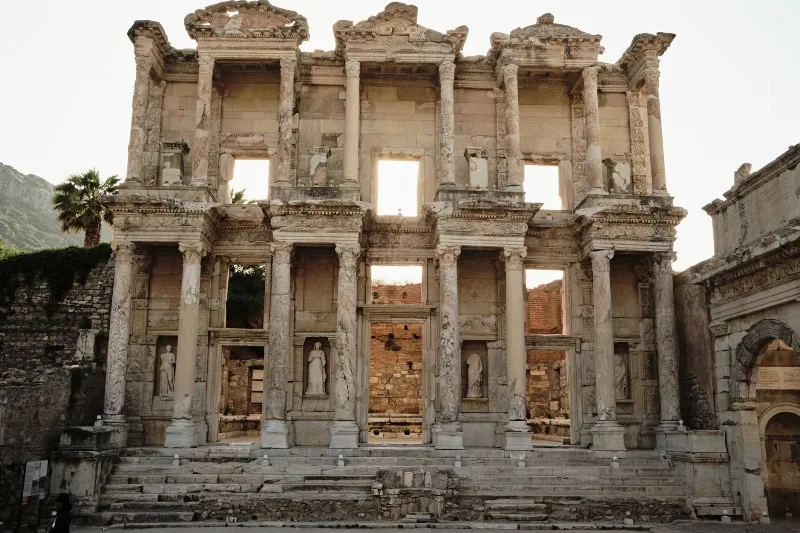
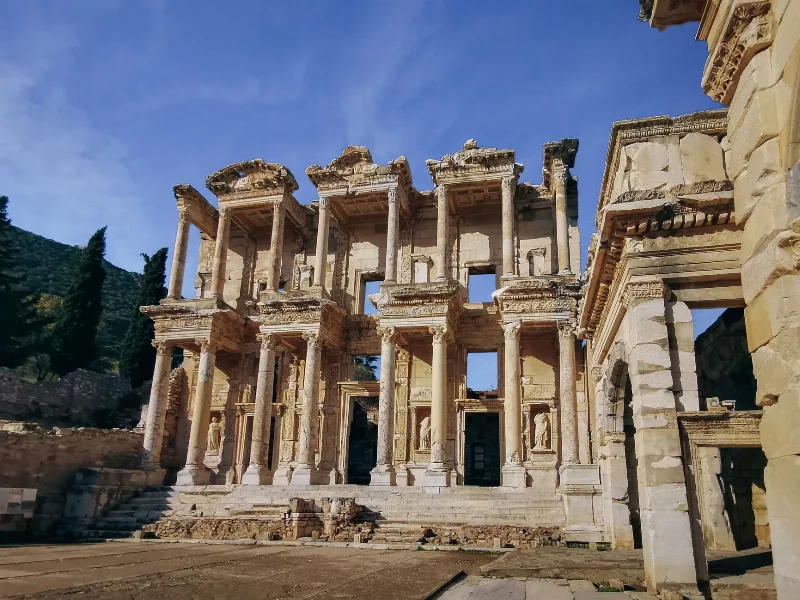
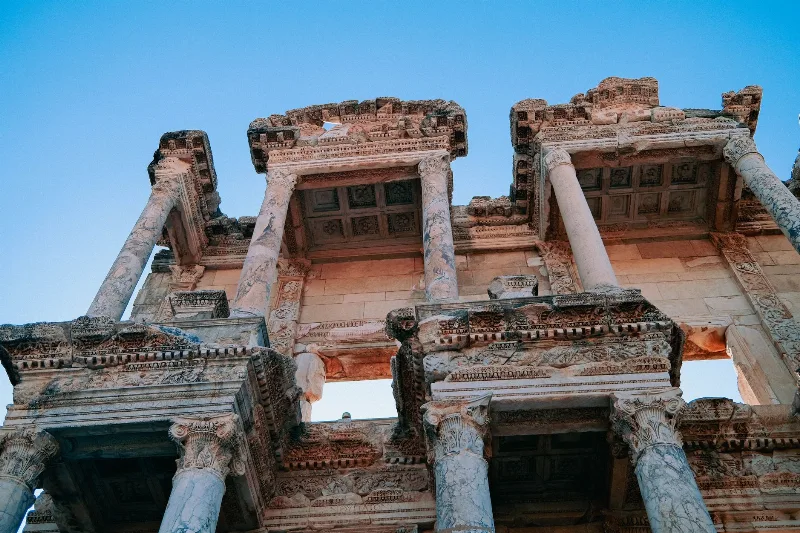
The Library of Celsus is the most photographed building at Ephesus. It was built between roughly 110 and 135 AD by Gaius Julius Aquila as a monument to his father, Tiberius Julius Celsus Polemaeanus, a Roman senator and governor of Asia who was buried in a chamber beneath the building. The two-storey facade combines columns, niches and a broad staircase, and its statues personify virtues such as wisdom and knowledge. The figures now visible on the facade are replicas, with the originals displayed elsewhere. Behind the ornamental front, the library held thousands of scrolls and also served as a tomb monument, an unusual combination in Roman architecture.
The Great Theatre
Cut into the western slope of Mount Pion, the theatre began as a Hellenistic structure and was enlarged over several Roman building phases. Its tiered seating is estimated to have held about 25,000 spectators, placing it among the largest in the ancient world. It was used for drama and public assemblies and, in the later Roman period, for gladiatorial contests; a gladiator cemetery has been excavated nearby. Approached from the lower, harbour-side entrance, the theatre is usually the first major landmark that comes into view.
The Terrace Houses
Opposite the Temple of Hadrian, the Terrace Houses, also called the Slope Houses, climb the hillside above Curetes Street. These were multi-storey residences of prosperous Ephesians, built around courtyards and decorated with wall paintings, marble panelling and mosaic floors. Conservation work has continued for decades, and parts of two residential blocks are protected by shelters. Entry to the terrace houses is normally covered by a separate admission from the main site.
Streets, Temples and Public Buildings
Curetes Street runs downhill from the upper city as a colonnaded, marble-paved thoroughfare lined with fountains, baths and shops, and with the Temple of Hadrian, whose porch carries relief carvings of mythological scenes. Marble Street leads toward the Library of Celsus and the Commercial Agora. The Odeon, a small roofed theatre seating about 1,500, also served as a council chamber. Around these routes stand the State Agora with its basilica, the Prytaneion, the Gate of Mazeus and Mithridates, the Baths of Scholastica, public latrines fed by a running water channel, a stadium, and the Church of Mary. Together the remains show a functioning city rather than a collection of isolated monuments.
Walking the Site: Terrain and Accessibility
There are two entrances: an upper gate near the Magnesia Gate and the road to the House of the Virgin Mary, and a lower gate on the harbour plain where most coach traffic arrives. Most visitors walk downhill from the upper entrance through the civic centre toward the theatre and the lower gate, a route of roughly three kilometres with side detours. The paving is marble, granite and worn stone, uneven underfoot and stepped in places; polished marble becomes slippery when wet. Shade is limited across most of the route and seating is scarce. Visitors with reduced mobility may find much of the path difficult, although some sections have been improved. Sturdy shoes, water and a minimum of two to three hours are advisable; half a day allows time for the main ruins and the terrace houses.
Climate and the Best Time to Visit
The site has a Mediterranean climate. July and August afternoons commonly exceed 35°C, and the exposed marble reflects heat strongly. April, May, late September and October bring gentler temperatures and softer light, making them the most comfortable months for a long walk. Winter is mild but wetter, the site is far quieter, and rain makes the paving slick. Arriving early in the day helps in summer, both for cooler conditions and to avoid the largest groups.
Getting There and Around
Selçuk is the natural base for visiting Ephesus and has a railway station on the line from İzmir and from Denizli, with regional trains running through the day. İzmir Adnan Menderes Airport lies about an hour north by road. From Selçuk's centre the ruins are around three kilometres away, reachable by minibus, taxi or a walk of roughly forty minutes. Kuşadası, the region's main Aegean cruise port, is about twenty kilometres west, and many visitors arrive on day trips from there or from İzmir. Because the site has two entrances, it helps to decide in advance which gate you will start from and where your transport will wait at the other end.
Nearby Places Connected to Ephesus
Selçuk itself holds the Ephesus Museum, where finds from the city, including material from the terrace houses and the Artemision, are displayed. The Basilica of St John, built under Justinian in the sixth century on Ayasuluk Hill above the town, marks the traditional burial place of the apostle, and the İsa Bey Mosque of the late fourteenth century stands below the hill. The House of the Virgin Mary, known locally as Meryem Ana, sits on Bülbül Dağı about seven kilometres from the main ruins and remains an active pilgrimage site. The hillside village of Şirince, known for its wine production, is a short drive east. On the coast, Pamucak has a long sandy beach near the point where the Kaystros reaches the sea. Further south along the Aegean lie the Ionian cities of Priene, Miletus and Didyma, while Sardis sits inland to the north-east; together with Ephesus they form part of the wider story of ancient western Anatolia.
Related content
Selçuk
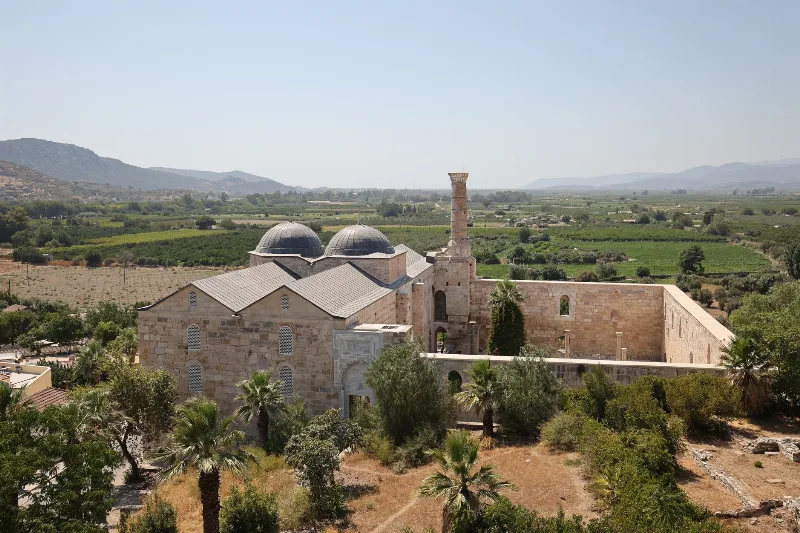
Selçuk is an inland district of İzmir Province in the Aegean region, set in the Küçük Menderes valley near the coast. It is best known as the modern town serving Ephesus, the House of the Virgin Mary and the Basilica of St John.
Denizli
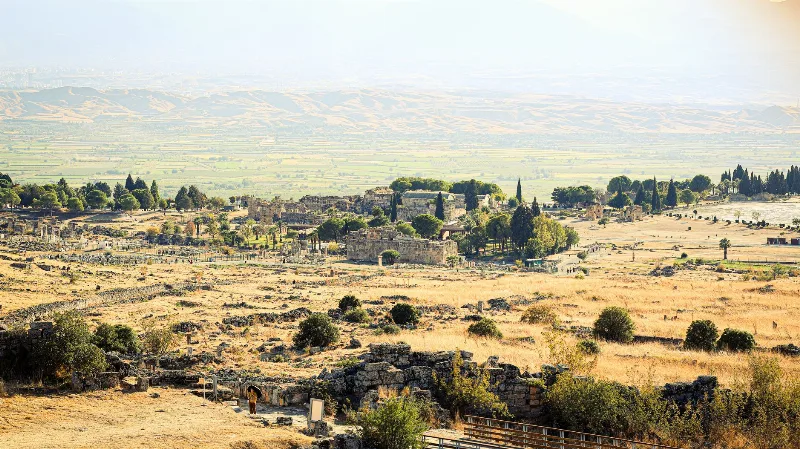
Denizli is the inland capital of Denizli Province in Türkiye's Aegean region, known internationally for the Pamukkale travertine terraces and ancient Hierapolis, and at home as a major textile city with its own long-crowing rooster breed.
Kuşadası
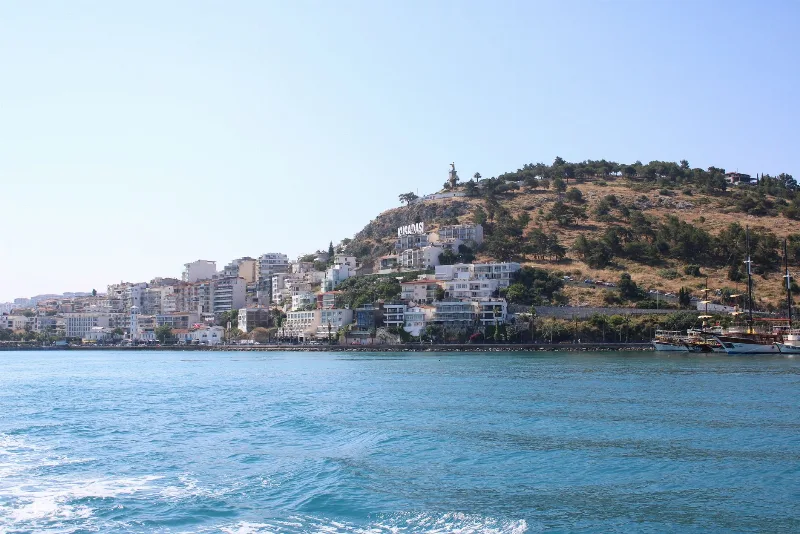
Kuşadası is a lively Aegean resort town and cruise port in Aydın Province, best known for its proximity to the ruins of Ephesus and for a coastline of sandy bays backed by pine-covered hills.
4-Day Ephesus and Pamukkale Route
A four-day west-to-east Aegean route that links the ancient city of Ephesus and the House of Virgin Mary in Selçuk with the white travertine terraces and Hierapolis ruins at Pamukkale, near Denizli.
6-Day Aegean Ancient Cities Route
A six-day linear journey from Izmir to Denizli through the great ancient cities of the Aegean, linking Ephesus, Priene, Miletus, Didyma, Lake Bafa, Pamukkale, Laodicea and Aphrodisias in one coherent corridor.
Ephesus: Gateway to Antiquity
Ephesus is a vast archaeological site on the Aegean coast of Türkiye, where marble streets, terraced houses and a hillside theatre trace the life of a major Roman city. Nearby Selçuk adds museums, a hilltop basilica and a fertile farming plain.