Ihlara Valley Rock Churches and Melendiz River in Aksaray
The Ihlara Valley in Aksaray province shelters dozens of rock-cut Byzantine churches above the Melendiz River, where painted walls, poplar groves and steep tuff cliffs form one of Central Anatolia's most distinctive landscapes.
Carved into soft volcanic tuff in the heart of Central Anatolia, the Ihlara Valley runs for roughly fourteen kilometres between the village of Ihlara and the small town of Selime in Aksaray province. Its cliffs hold scores of rock-cut churches and chapels, many of them still carrying painted frescoes, while the Melendiz River threads along the valley floor beneath them. Geology, Byzantine art and quiet rural life meet here in a way that few corners of Türkiye can match.
A Canyon Formed in Volcanic Tuff
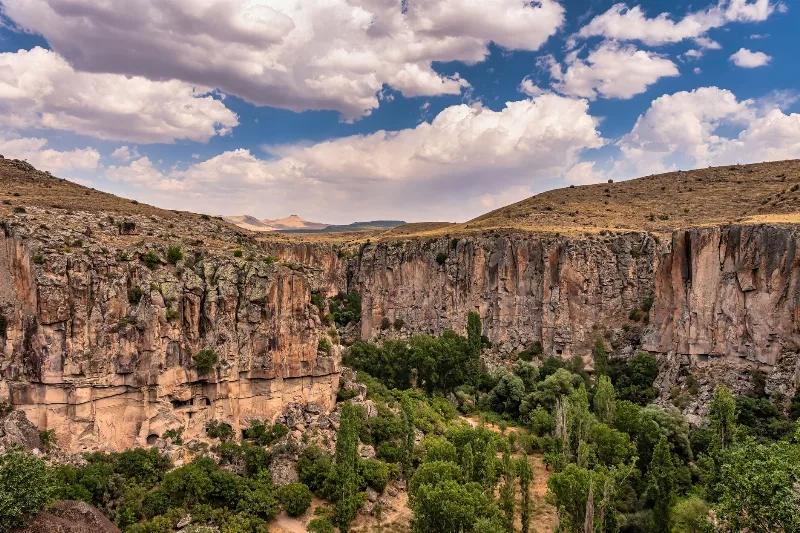
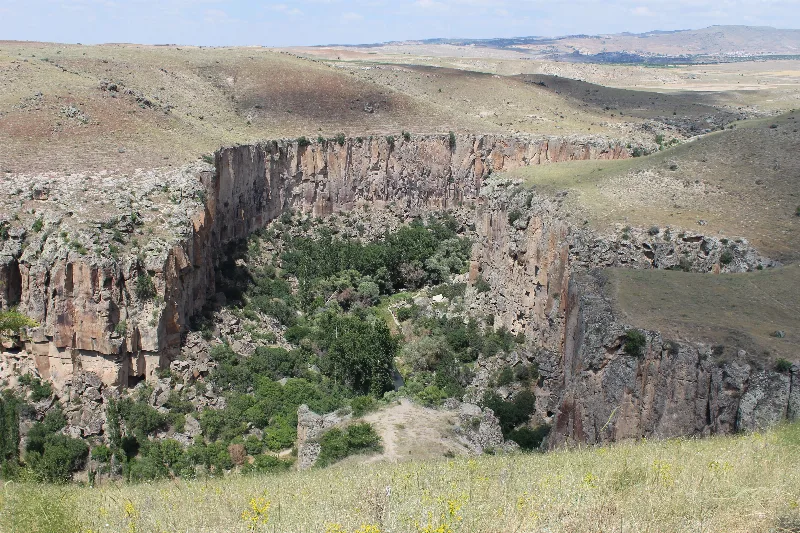
The valley is a deep incision in a plateau of tuff, a relatively soft rock created from ash and debris thrown out by the volcanoes of the region, principally Hasandağı and the Melendiz range. Over a very long period the Melendiz and its tributaries cut down through these layers, opening a gorge whose walls rise in places to around a hundred metres or more. Because tuff is easily worked with simple hand tools, the same material that formed the canyon also made it habitable: rooms, churches, refectories and tombs could be hollowed directly out of the rock face, and a remarkable number of them have survived.
The Melendiz River and the Valley Floor
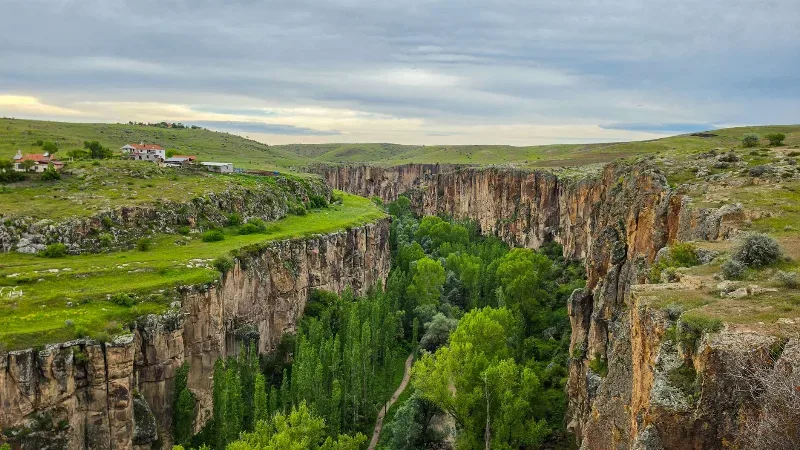
The Melendiz rises in the Melendiz Mountains to the south-east and flows northwards through the gorge, joined by springs and small streams along the way. Downstream, beyond the valley, its water is held in the Mamasın Dam near Aksaray. Within the canyon the river supports a green corridor of vegetable plots, fruit trees, poplars and willows, with oleander flowering along the banks in summer. The sheltered floor enjoys a gentler microclimate than the surrounding plateau, which is one reason the valley has been settled and cultivated for so long. The village of Belisırma, roughly halfway along, is the only settlement actually inside the gorge and has long depended on the river for irrigation.
How the Churches Were Cut into the Rock
These buildings were not constructed but quarried inwards, so their architecture follows Byzantine conventions adapted to the nature of the stone. Most are single-nave chapels with a barrel-vaulted ceiling and an apse facing east; others are larger cross-in-square compositions with a central dome, and in a few cases the mason left columns standing as supports rather than carving them away. Benches run along the walls, graves are cut into the floors, and some façades were shaped to imitate masonry. Several churches are grouped with refectories and small cells, suggesting monastic communities that once lived and worshipped in the valley.
Frescoes of the Byzantine Centuries
The painting in the valley spans roughly the ninth to the thirteenth centuries. Some surfaces carry the restrained decoration associated with the iconoclast period, built around crosses and geometric or floral motifs, while others display full narrative cycles painted after the restoration of images. Pigments of red ochre, yellow, green, blue and white were laid on plaster, and in some churches paint was applied directly to smoothed rock. Familiar scenes recur across the walls: the Annunciation and Visitation, the Nativity, the Baptism, the Transfiguration, the Raising of Lazarus, the Entry into Jerusalem, the Last Supper, the Crucifixion, the Women at the Tomb and the Ascension. Later work tends to be more modelled and expressive, and donor portraits appear beside the sacred figures.
Churches Worth Seeking Out
Many of the churches are unnamed, but a number are well known and are generally identified by the decorative details or inscriptions that survive inside them.
- Ağaçaltı Kilisesi, also called Daniel Pantonassa, is a cross-planned church of around the ninth or tenth century whose frescoes include the Annunciation, the Nativity and Daniel in the lions' den.
- Kokar Kilisesi is among the earliest painted churches in the valley, with a long cycle covering the life of Christ and the Virgin.
- Yılanlı Kilise, the Snake Church, takes its name from a fresco showing sinners punished by serpents; St George on horseback and the emperor Constantine with Helena also appear on its walls.
- Pürenliseki Kilisesi sits high above the river and is reached by a steep path, rewarding the climb with rows of saints' figures.
- Sümbüllü Kilisesi is a domed church of the eleventh century with scenes from the infancy of Christ.
- Direkli Kilise, the Columned Church, preserves its carved supports and portraits of the donors who paid for its decoration.
- Bahattin Samanlığı Kilisesi, close to Belisırma, shows a Nativity, the Adoration of the Magi and the Last Supper.
- Kırkdamaltı Kilisesi, dedicated to St George, carries a long inscription naming both a Seljuk sultan and a Byzantine emperor, a reminder of the frontier world in which it was painted.
- Eğri Taş Kilisesi includes a Last Judgement among its later frescoes.
Walking the Ihlara Valley on Foot
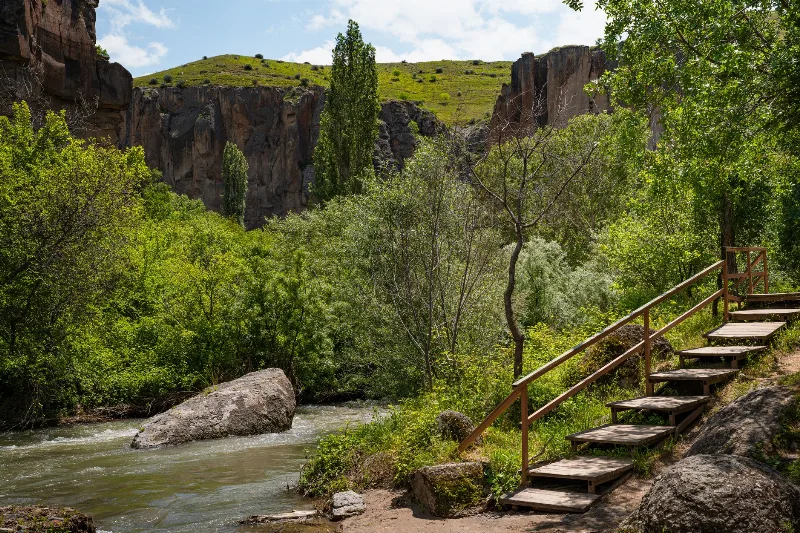
A walk in the valley usually begins at Ihlara village, where a long flight of steps descends from the rim to the water, or at the northern end near Selime. The most frequented stretch, of about seven kilometres between Ihlara and Belisırma, passes several churches and follows the river through orchards and poplar groves. Shallow water, gravel bars and the shade of the cliffs make it a pleasant route in spring and autumn, while the tea gardens at Belisırma offer a natural resting place. Near Selime the rock-cut monastery and cathedral-like complex mark the end of the gorge, and the nearby town of Güzelyurt has stone houses and further cave churches set among its streets.
A Fragile Heritage
Painted tuff is easily damaged. Moisture, fluctuations in temperature, soot from fires once lit by shepherds and the touch of visitors all take a toll, and conservation teams have worked in the valley to stabilise plaster and slow deterioration. The area is protected, and walkers are encouraged to keep to marked paths and to view the churches without touching the walls. Handled with care, this quiet corridor of river, rock and painted saints will continue to inform and absorb those who walk through it.
Related content
Ihlara Valley
Ihlara Valley is a green canyon in Aksaray Province, cut by the Melendiz River through soft volcanic rock. Its steep walls, riverside vegetation and rock-cut churches make it one of the most distinctive landforms of the wider Cappadocia region.
Ihlara Valley
Ihlara Valley is a 14-kilometre canyon in Aksaray Province cut by the Melendiz River, lined with Byzantine rock-cut churches and frescoes. This guide covers its geology, the churches inside it, the walking route and the best time to visit.
Aksaray
Explore Aksaray, Central Anatolia: history, standout sights, landscapes, local food and practical travel advice for an unforgettable journey in Türkiye.
2-Day Cappadocia Underground Cities Route
A two-day route from Nevşehir through the underground cities of Kaymaklı and Derinkuyu, finishing with a walk through the Ihlara Valley and the rock-cut complex at Selime.
The Ihlara Valley and Its Rock-Cut Churches in Cappadocia
The Ihlara Valley in Cappadocia, Türkiye, is a green canyon carved by the Melendiz River, known for its rock-cut churches, Byzantine frescoes and peaceful walking paths.
4-Day Cappadocia to Konya Route
A four-day southbound route from Cappadocia's rock-cut valleys to Konya, linking the underground cities of Derinkuyu and Kaymaklı, the Ihlara canyon, Selime Monastery and the Mevlana Museum. It is a linear, self-drive journey across the volcanic plateau of Central Anatolia into the Konya plain.
4-Day Cappadocia and Konya Route
A four-day linear journey from the rock valleys of Cappadocia to the Seljuk city of Konya, linking cave churches, underground cities and the Ihlara Valley with the Mevlana Museum on the central Anatolian plateau.
3-Day Cappadocia Route
A practical three-day Cappadocia route that starts in Göreme, heads south to the underground cities and the Ihlara Valley, then continues north through Zelve and Avanos before finishing in Ürgüp.